A diary of birds I've observed, spiced up with photos and occasional commentary. Clockwise from top left: Burrowing Owl, Red-breasted Merganser, Yellow-breasted Chat, Purple Gallinule, Summer Tanager, Gray Hawk, Virginia Rail, and (in center) Magnolia Warbler.
August 30, 2026 [LINK / comment]
Birding in Virginia, October 2025
What follows is another extremely late summary of birds that I saw in October of last year. Little by little, I'm getting caught up, and should erase my long backlog within the next month or two.
October 3: It was a great day along Bell's Lane today! I checked out the northeastern stretch for the first time in a while, and was soon rewarded with nice views of Cedar Waxwings, Northern Rough-winged Swallows, a closeup of a (female) Black-throated Green Warbler, and my very first Northern Harrier of the season! Along the usual lowland portion, I saw several American Redstarts, a Northern Parula, a Black & White Warbler, and my first Ruby-crowned Kinglet of the season! It's always interesting to see a mix of summer birds and winter birds during the spring and fall migration seasons.
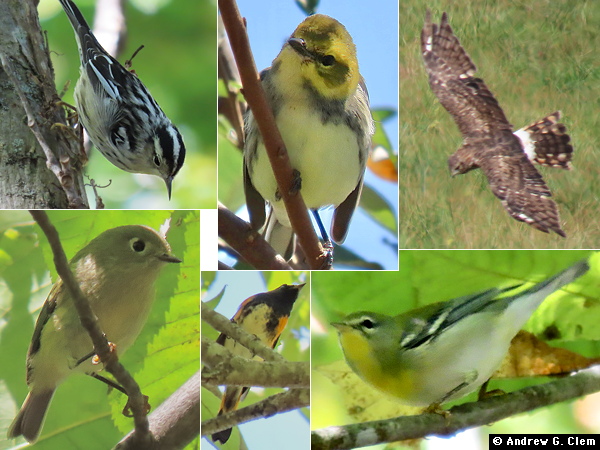
Bell's Lane, October 3.
October 4: In contrast to last Saturday, when the ABC field trip to Augusta Springs was originally scheduled, the weather this morning was almost perfect, and we saw a nice variety of migratory birds. Soon after arriving we saw a Cape May Warbler, along with all the Cedar Waxwings, but unfortunately I couldn't get a good photo of it. We saw Black-throated Blue Warblers at two locations, the first (a male) staying up in the trees while the second (a female) was much more cooperative. Other highlights included Yellow-bellied Sapsucker (first of the season for me), a Common Yellowthroat, a couple probable Chestnut-sided Warblers, some Blue-headed Vireos, a Pileated Woodpecker, and a Belted Kingfisher. There were many smaller birds in the bushes across the meadow north of the boardwalk, but they were hard to see. I later determined from the photos that some were Indigo Buntings (note the blue tinges in the brown bird) and others were White-throated Sparrows (FOS). At one point we heard a an emphatic high-pitch song that was vaguely familiar, very close by, and Stephen Pietrowski's Merlin app identified it as a Ruby-crowned Kinglet. We didn't see it, however. On the way back to Staunton we stopped at a couple places in Swoope, but didn't see anything special other than an American Kestrel. Overall, however, it was great day.
October 8: I paid a visit to Bell's Lane on the way home from work late this afternoon, and soon saw a Northern Harrier (F/J) once again. In the wooded lowland area I spotted a Northern Parula, an American Redstart, and an Ovenbird, but getting photos proved almost impossible. Near the kiosk toward the southwest end* were a Northern Flicker, Downy Woodpecker, and Red-bellied Woodpecker, as well as some Eastern Bluebirds, Cedar Waxwings, and two Yellow-rumped Warblers -- my first ones of the season!
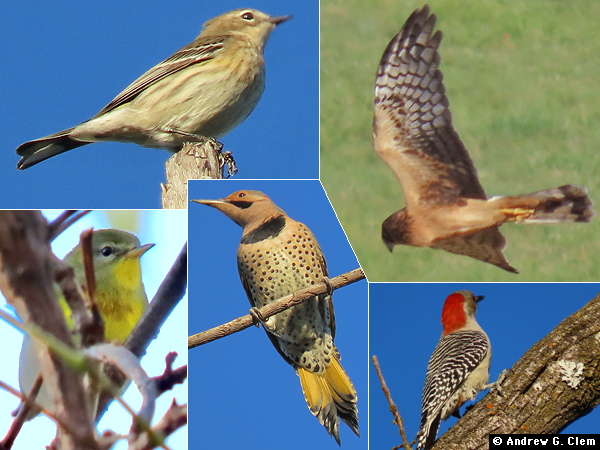
Bells Lane, October 8.
October 10: Jacqueline and I went for a walk at Montgomery Hall Park in the afternoon, after buying veggies at nearby Jones Garden. The big highlight was seeing a Common Yellowthroat up close, but otherwise just some Ruby-crowned Kinglets and a few other common birds.
October 11: On an ABC field trip to Madison Run that I led, we started hearing lots of birds soon after we began our hike, but for the most part they remained elusive all morning. In particular, we kept hearing Ruby-crowned Kinglets, but never had a clear view of any of them. At one point the Merlin app on two of our phones indicated that a Brown Creeper was present, but the calls were probably too high-pitched for us to hear. We heard a variety of woodpeckers, including Pileated, but the only clear sighting was that of a Yellow-bellied Sapsucker. There was a lot of bird activity at the Austin Mountain trail crossing, and we finally had decent looks at a Blue-headed Vireo, one of the late fall migrants, along with Carolina Chickadees, etc. As a reflection of the nice weather conditions, the trail was full of human hikers and their canine companions.
October 17: I finally had some time for birding this afternoon, so of course I went to Bell's Lane. I didn't see any of the hoped-for warblers, but I did have an excellent closeup view of a White-eyed Vireo, on its way south a bit behind schedule. That was a surprise! I also saw my first White-crowned Sparrow of the season, as well as a White-throated Sparrow; I had only seen the latter species once this season, during our Augusta Springs field trip two weeks ago. There were also a few Ruby-crowned Kinglets and the usual woodpeckers, etc., but no Gray Catbirds or Eastern Phoebes. They must have left town and headed south already.
October 18: I drove out to Swoope and the Boy Scout camp late this morning, mostly in hopes of seeing a Winter Wren or Brown Creeper. No luck with either of those, but I did see a plethora of woodpeckers: Red-headed, Downy, Red-bellied, as well as a Northern Flicker and a Yellow-bellied Sapsucker! I also heard a Pileated Woodpecker but never saw it. A Hairy Woodpecker would have made it a perfect day, woodpecker-wise! Finally, there was a Yellow-rumped Warbler along North Mountain Road a couple miles to the north.
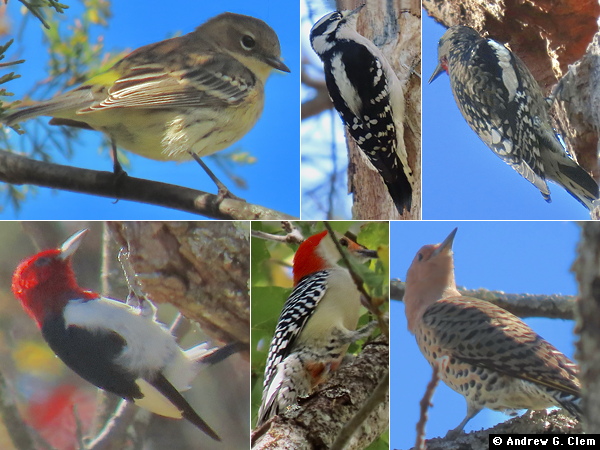
Swoope, October 18.
October 20: I went for a walk around Montgomery Hall Park, and was disappointed by the lack of birds until I reached the top. All of a sudden, there were Kinglets all around me -- both Ruby-crowned and Golden-crowned! (It was the first I had seen of the latter species this fall.) Unfortunately, they were just too fast for me to get any good photos!
October 22: I finally lucked out in getting a photo with perfect lighting conditions when I saw two Northern Harriers along Bell's Lane late this afternoon. Also a Red-tailed Hawk perched in the distance.
October 24: The bright sun in the late afternoon accentuated the colors of the birds along Bell's Lane. There must have been at least a half dozen Yellow-rumped Warblers near the kiosk, along with 15 or more Eastern Bluebirds. Toward the northeast end there was a flock of American Robins numbering at least 40. I had a brief glimpse of a Northern Harrier as well.
October 25: One thing led to another in the afternoon, and I eventually ended up at Coyner Springs Park southwest of Waynesboro. For the first time I walked there from the semi-new Shenandoah Village Drive which I mentioned in a post last month. It was slow going for a while, bird-wise, but as I reached the top of the hill (by the water treatment building), it got very busy! Many Yellow-rumped Warblers and Ruby-crowned Kinglets, as well as Yellow-bellied Sapsuckers and even a Blue-headed Vireo! Just in case, I checked out the bushes where many of us saw the ultra-rare Kirtland's Warbler last year; no such luck. On my way back were several dozen American Robins, Red-winged Blackbirds, and Common Grackles in the woods below, as well as some Cedar Waxwings. In spite of the overcast skies, it was quite a day!
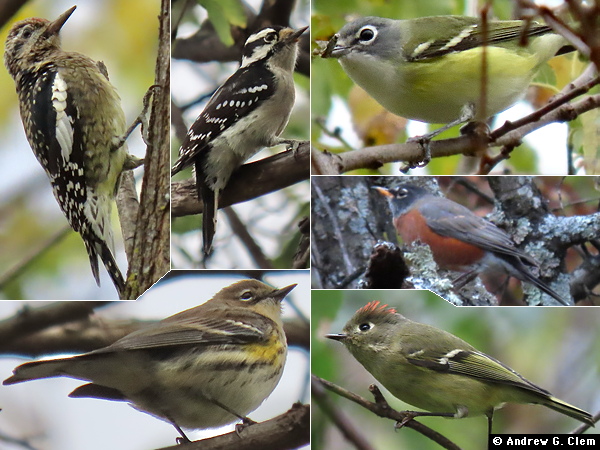
Waynesboro, October 25
Additional photos and montages, including individual photos of some of the birds in the above montages, can be seen on the Wild Birds chronological (2025) page.
August 22, 2026 [LINK / comment]
Birding in Virginia, September 2025
Here we resume the never-ending endeavor to catch up with blogging about birding... (The last such "episode" was on August 7.)
September 1: Along Bells Lane I saw a Blackburnian Warbler (female or young), along with more Ruby-throated Hummingbirds, hawks, and flycatchers.
September 5: Jacqueline and I came upon a big cluster of various birds as soon as we started walking along Bell's Lane late this afternoon: Eastern Phoebes, Eastern Wood Pewees, a Northern Flicker, Red-bellied Woodpecker, and a Cape May Warbler doing amazing aerobatic stunts! A Cooper's Hawk (first year) soon showed up in search of a meal. Later on I came upon a Yellow Warbler (young or female), and was lucky to get a couple photos before it scurried away. Fall migration is/was in full swing!
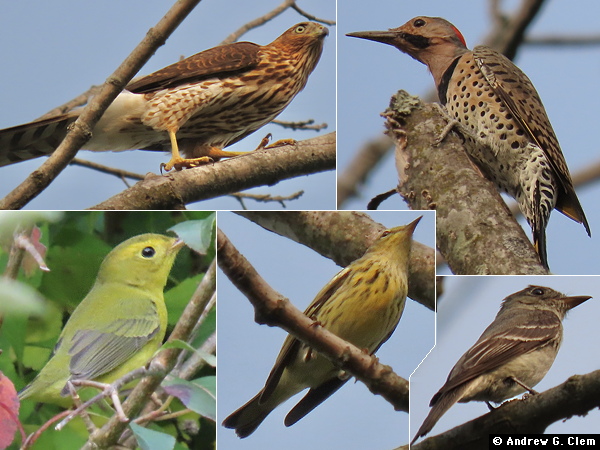
Bell's Lane (September 5, 2025.)
September 8: I couldn't make it to the hawk watch, but I ended up getting some nice views of hawks when Jacqueline and I went for a walk around the trail at Mill Place in Verona: a Red-shouldered and a Sharp-shinned, which briefly engaged in an aerial tussle. On the way there (and back out again), we stopped at the big pond behind Hardee's, where I saw two Green Herons, a Belted Kingfisher, and a Solitary Sandpiper. But the big highlight of the day was spotting a pair (M & F) of Blue Grosbeaks hopping around the thick bushes near the parking lot. I heard some odd call notes, and thanks to the usually-reliable Merlin app (!), I was able to determine the species. It was quite a day!
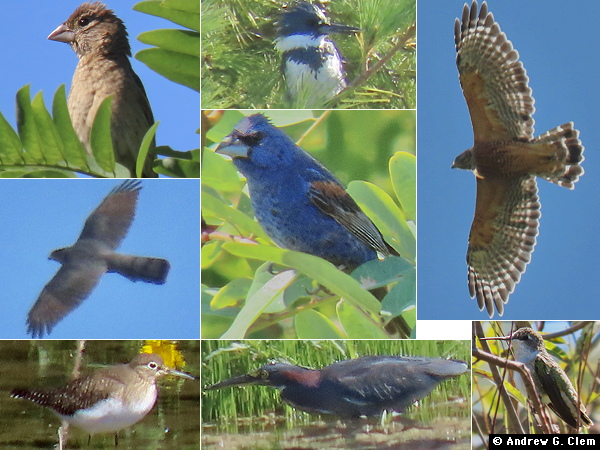
Mill Place (September 8, 2025.)
September 12: I haven't had much luck along Bell's Lane lately, just a Cedar Waxwing on Wednesday and an American Redstart today, among the Eastern Phoebes, woodpeckers, sparrows, and other regulars. The hummingbirds out back provide lots of entertainment, but they seldom pose in good lighting conditions.
September 13: We had a nice variety of warblers and other neotropical migrants on our Augusta Bird Club field trip up in the Blue Ridge this morning. Many of them were either too fast or too well hidden to properly identify, but the ones here are fairly certain: Magnolia Warbler, Yellow-bellied Flycatcher, Yellow-throated Vireo, Black-throated Blue Warbler, Scarlet Tanager (male, in non-breeding plumage), Tennessee Warbler, Red-bellied Woodpecker, and Blackpoll Warbler. We also saw a probable Blackburnian Warbler, Nashville Warbler, and Least Flycatcher, as well as an Eastern Phoebe, a Cedar Waxwing, and several American Goldfinches and Ruby-throated Hummingbirds. It was just wonderful!
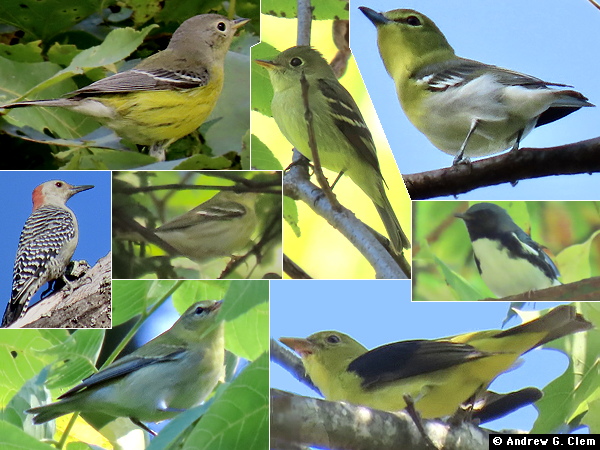
(Blue Ridge Parkway and Route 610, September 13, 2025.)
September 17: During Penny Warren's bird walk along Bell's Lane I saw an American Redstart, which has been the most common warbler species there since the spring, as well as a Northern Parula (underside view), a Red-bellied Woodpecker, some Eastern Phoebes, and a family of Cedar Waxwings rounding out the day's highlights. I never saw the Magnolia Warbler that Scott Priebe found.
September 18: A brief visit to Bell's Lane late in the afternoon paid off big time, as I saw multiple Palm Warblers -- the first ones of the season for me, and possibly of the year! Other highlights included Cedar Waxwings, a N. Flicker, E. Phoebe, and the first American Kestrel I have seen in months. (It was too far away for a good photo.)
September 19: Jacqueline and I walked all the way around Yulee's Trail in Montgomery Hall Park, but virtually all the birds we saw were at the top of the hill, where we started. The Red-breasted Nuthatch was a big surprise, and the Black-throated Green and Magnolia Warblers were also very nice finds.
September 20: Jacqueline and I hiked all the way up to the top of the Madison Run trail yesterday (five miles each way!), and we saw a few good birds along the way. Two of the species were maddeningly difficult to photograph (Swainson's Thrush and Black-throated Blue Warbler), but I eventually got good images of them. In both cases we saw multiple birds in two different locations. In contrast, the Pine Warbler, Black and White Warbler, and E. Wood Pewee seen here were more "cooperative," but one or two mystery warblers (such as the one or ones in the bottom right below) will remain in doubt. Overall, the birds were much scarcer than I would expect during the peak of migration season.
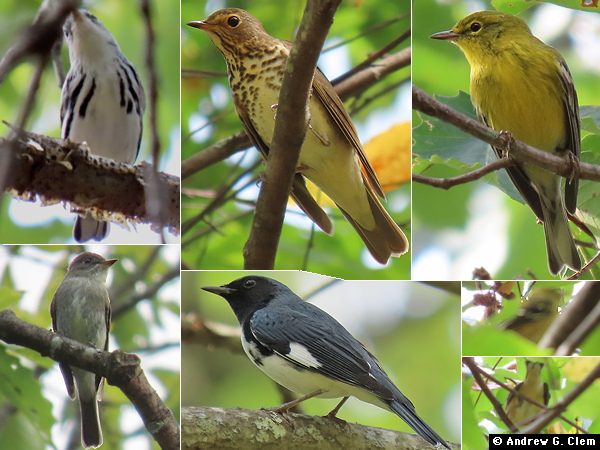
(Madison Run trail, September 20, 2025.)
September 22: I had my first real warbler "fallout" of the season along Bell's Lane in the morning! Magnolia Warblers (top right) and American Redstarts (top left) were present in multiple locations, while the Northern Parula and Black-and-white Warblers seen here at the lower right were in the same area of dense foliage and vines in the lowland stretch of the road not far from "Cujo Corner." Also in that area was a Swainson's Thrush and an Eastern Wood Pewee or two. Finally, in the thick bushes in front of the small pond was a Cape May Warbler -- the fifth warbler species of the day! Nearby I also saw Eastern Phoebes and Northern Rough-winged Swallows. Red-shouldered Hawks were screaming off and on, but I didn't see any of them today.
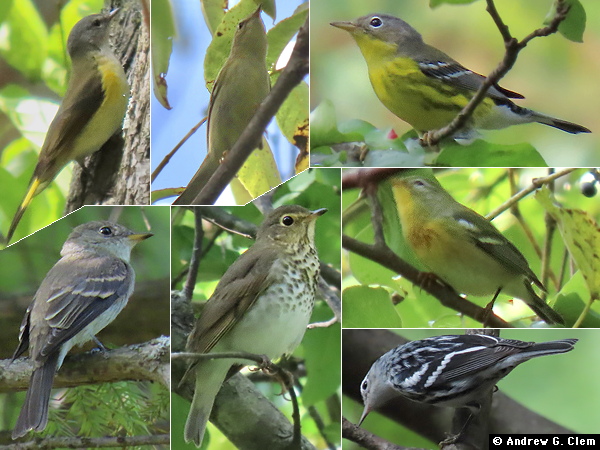
(Bells Lane, September 22, 2025.)
September 26: In the morning Jacqueline and I did a bit of birding along the brand-new Shenandoah Village Rd. that connects the Target shopping center to South Delphine Avenue on the south side of Waynesboro. There were many American Goldfinches and American Robins, as well as some very special birds: Yellow-billed Cuckoo (elusive as ever), Cape May Warbler (top left in the first composite image), and Blackpoll Warbler. In the afternoon we went to Bell's Lane, where I saw a Red-bellied Woodpecker, some Cedar Waxwings, an Eastern Phoebe, and an American Redstart.
September 29: Along Bell's Lane I found multiple Eastern Phoebes, Magnolia Warblers, and American Redstarts. There were 6-8 Eastern Bluebirds checking out the holes left by woodpeckers in a birch tree near the small pond.
Additional photos and montages, including individual photos of some of the birds in the above montages, can be seen on the Wild Birds chronological (2025) page.
August 7, 2026 [LINK / comment]
Birding in Kansas (& Virginia), August 2025
This episode of my birding adventures from last year begins with my trip out west to see my brothers in the southwestern suburbs of Kansas City.
August 3: The birding aspect of my recent road trip to Kansas got off to a surprising start when I walked across the motel parking lot to see an Indigo Bunting that was singing at the crack of dawn. (This was in the town of Cookeville, east of Nashville, Tennessee.) I soon heard TWO White-eyed Vireos in the bushes, and eventually got a photo of one. That was a big surprise! In the back yard of my brother Dan's house that evening, I was startled to see multiple Eastern Wood Pewees, chasing insects all around. They were regulars in the backyard throughout my stay there.
August 5: At the Corporate Woods Park, in Overland Park two days later I was flabbergasted to see a Northern Parula, at the very western edge of its range! (It's at the top left of the composite photo below.) Its song was different than what I am familiar with, and Merlin helped with the ID. There was also an Eastern Phoebe, a RED-eyed Vireo, and other species including many American Robins. It was a bit odd to be in a dense woodland with high-speed traffic passing nearby along I-470. On the way back to my brother's house, I noticed a Red-tailed Hawk flying above, and stopped to take a photo of it. In the evening we saw the Eastern Wood Pewees and a Great Crested Flycatcher or two.
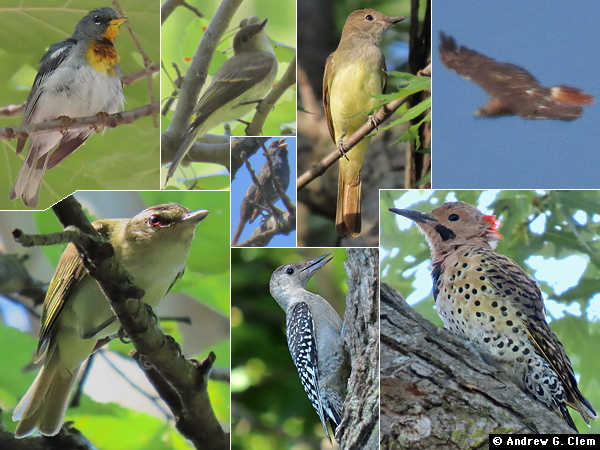
(Corporate Woods Park, in Overland Park, Kansas, August 8, 2025.)
August 7: I explored Shawnee Mission Park, in the fringes of the western suburbs, and while there was an interesting trail in the woods above the south side of a big reservoir, there just wasn't a whole lot of bird action. I heard a Red-eyed Vireo or two, and saw some Eastern Phoebes, Eastern Wood Pewees, and Eastern Bluebirds there.
August 8: For the first time, I explored South Lake Park, which is a pleasant neighborhood recreational area in Overland Park. Kansas marks the western edge of the ranges of many eastern bird species, such as Carolina Wrens, which are only found near Kansas City and the southeastern part of the state. In general, these "yardbirds" are less common than here in Virginia, and are largely absent west of Kansas. Other highlights: Ruby-throated Hummingbird, Northern Cardinal, Gray Catbird, and Eastern Kingbirds.
August 9: I took a solo mini-trip about 50 miles west to the state capital of Kansas: Topeka. There I saw a Eurasian Collared Dove near the capitol building. On the way back to the Kansas City suburbs, I stopped at the Baker Wetlands Discovery Center on the south side of Lawrence, where I saw my first Great Egret of the year. I also spotted some Wood Ducks, a Pied-billed Grebe, a Yellow Warbler, and a Common Yellowthroat, along with the usual birds.
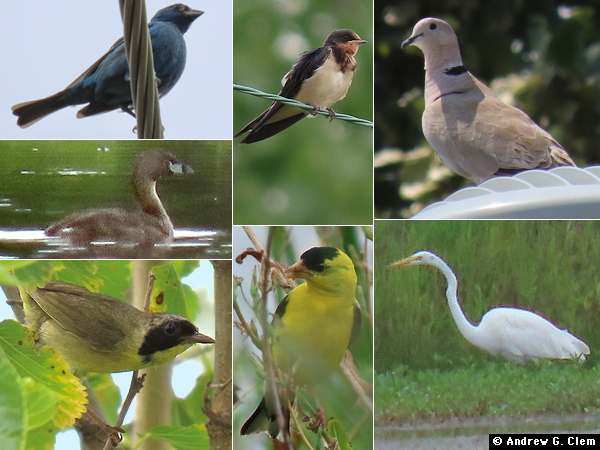
(TOP RIGHT at Topeka, Kansas; the rest were at Baker Wetlands, south of Lawrence, August 9, 2025.)
August 11: I went to yet another neighborhood park in Overland Park, and soon heard a Great Crested Flycatcher as well as a Red-eyed Vireo, but didn't see either species. Later on, however, I spotted what turned out to be a Least Flycatcher zipping around some thick bushes. I'm pretty sure the two birds on the right side are different individuals of that same species, but they could be the same bird. Once again, Merlin helped pinpoint which species it/they was/were. Empids can be tough to distinguish! I also saw a Brown Thrasher, along with Northern Cardinals, American Goldfinches, etc. Back home at my brother's house the usual Eastern Wood Pewees were very active, as usual.
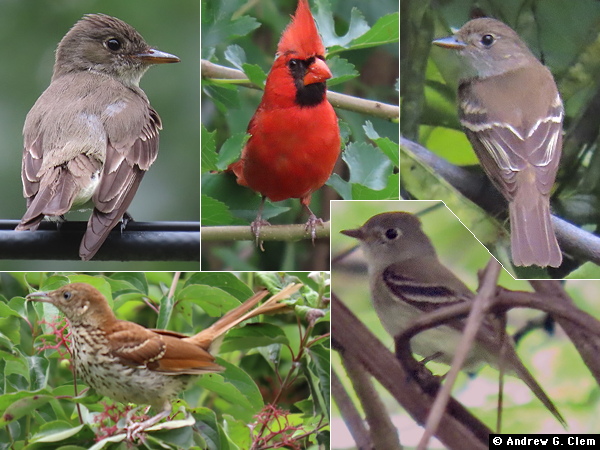
(Sapling Grove Park, in Overland Park, August 11, 2025.)
August 12: My most noteworthy day of birding in Kansas was at the Overland Park Arboretum. It wasn't easy, however, as I had to endure swarms of nasty mosquitos for virtually the entire 2+ mile hike, through damp riverside woodlands and occasional clearings. I saw the usual Red-eyed Vireos and E. Wood Pewees along the way, finally hitting the jackpot when I heard and then saw a couple Acadian Flycatchers (top center in the composite photo below) -- at the western edge of their range! Later I took refuge in a small cabin designed especially for bird watchers, in the middle of a cluster of bird feeders. (No mosquitoes inside!) There I saw a Ruby-throated Hummingbird, some White-breasted Nuthatches, Downy Woodpeckers, an Indigo Bunting, and an odd-looking bird that I later determined to be a female Blue Grosbeak (top right) -- first one of the year for me! Back in the parking lot as I was about to leave, I heard (according to Merlin) a Blue Grosbeak, saw a couple Eastern Kingbirds, and then -- to my utter astonishment -- a Western Kingbird (top left), at the eastern edge of its range! After departing the arboretum, finally, I spotted three long-winged raptors that were flying in amazing acrobatic style over an open field about a mile to the southwest. My photos of them were terrible (poor lighting conditions), but I could see with my binoculars that they had white heads and big black eye rings. Mississippi Kites!!! (First Of Year).
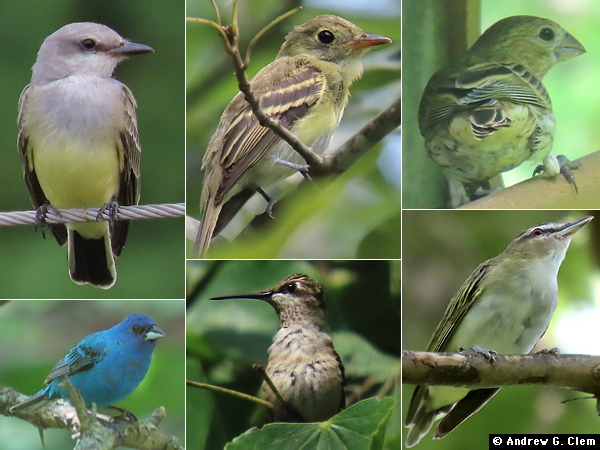
(Overland Park Arboretum, August 12, 2025.)
August 15: On my final full day in the western suburbs of Kansas City, I finally saw some Baltimore Orioles in the treetops of a neighborhood park. Also present were American Goldfinches, Northern Flickers, and many American Robins, including a juvenile. Unfortunately, I never did see any of my long-shot target species (Greater Prairie Chicken and Henslow's Sparrow) while out west, and I didn't get any life birds, but I was satisfied with seeing a decent number of less-common birds.
August 23: Back in Virginia, Jacqueline and I went hiking along the Riprap Trail in the Shenandoah National Park. There we saw Ruby-throated Hummingbirds, Red-eyed Vireos, Worm-eating Warbler, and a possible Tennessee Warbler.
August 27: After going to a car repair specialist in a remote part of northern Augusta County in the morning, we went for a walk around the Natural Chimneys, but about all we saw there were some Eastern Wood Pewees. Late in the afternoon we strolled along Bells Lane and saw a Red-shouldered Hawk, Cedar Waxwings, an American Redstart (F/J), and a Downy Woodpecker.
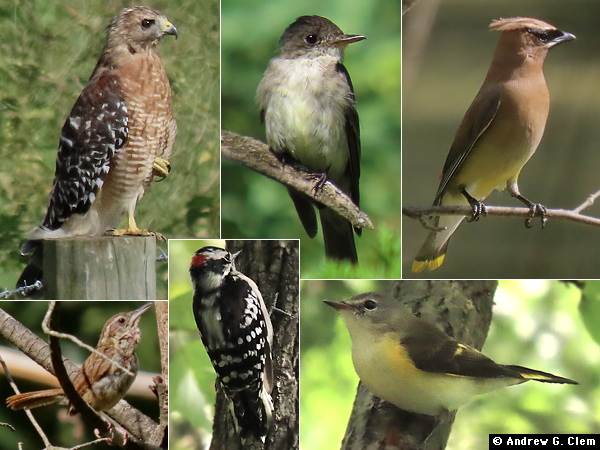
(Natural Chimneys and Bell's Lane, Aug 27.)
August 30: More migrating warblers were appearing along Bell's Lane late in the month, and I actually got some recognizable images with my camera. Most notably, a Canada Warbler (female or young) appeared in the thick foliage, but it didn't stay long.
Additional photos and montages, including individual photos of some of the birds in the above montages, can be seen on the Wild Birds chronological (2025) page.
August 4, 2026 [LINK / comment]
Birding in Virginia, July 2025
Here we go again, gradually getting caught up (blog-wise) with thrilling tales of birding from just over a year ago, gradually getting caught up to the present.
July 7: I ended up deciding to go birding on the Dowell's Draft trail (near Braley Pond), mainly in hopes of getting a better photo of a Northern Parula than in my previous outing in that part of Augusta County. I finally succeeded in finding one, but there results were only so-so. Much more conspicuous were the Scarlet Tanagers and American Redstarts. I also spotted Worm-eating Warblers, Black-and-white Warblers, a Hooded Warbler, an Indigo Bunting, and an Ovenbird, but they were all very camera shy. I got some good exercise, at least. Ironically, the big highlight of the day was while I was driving through Churchville on the way to Dowell's Draft: a Bald Eagle flying overhead! So, I stopped in front of a house and took some quite photos.
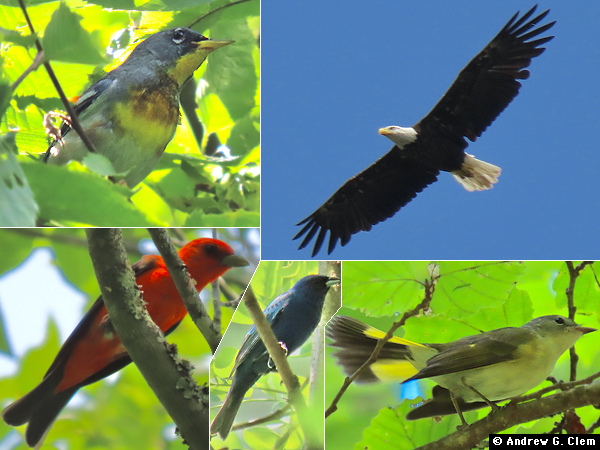
(Dowells Draft & Churchville, July 7, 2025.)
July 12: I went up to the Blue Ridge Parkway and Route 610 for the first time this month. Neither the Kentucky Warbler nor the Yellow-breasted Chat were present, a possible sign that breeding season was over. Nevertheless, I did see an Indigo Bunting, Ovenbird, Black-and-white Warbler, Wood Thrush, Red-eyed Vireo, Acadian Flycatcher, and Hooded Warbler. I heard and glimpsed a Broad-winged Hawk, as well as a Cooper's Hawk soaring up above. Cerulean Warblers were still vocal, but they were staying out of sight in the tree tops, as usual.
July 17: Bell's Lane seemed to be full of bird families with newly-fledged youngsters in the afternoon. Most notable were the Eastern Kingbirds, Northern Rough-winged Swallows, and Orchard Orioles; a first-year male is at top center, and an adult female is at lower right. Also seen were American Goldfinches and Eastern Phoebes. To my surprise, I didn't see or hear any Indigo Buntings.
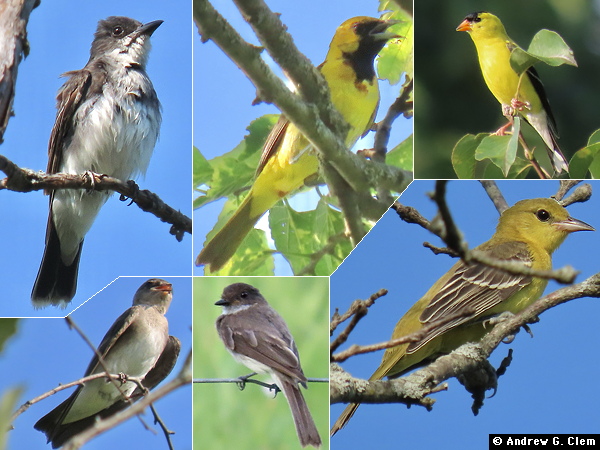
(Bell's Lane, July 17, 2025.)
July 26: I went for a walk along Bell's Lane in the late afternoon, getting rained on just a bit. I saw Downy and Red-belled Woodpeckers, a Northern Flicker, as well as Eastern Kingbirds, Eastern Wood Pewees, an Eastern Phoebe, some Gray Catbirds, a Field Sparrow, and a female (or young) Orchard Oriole. The big highlight was a Yellow-billed Cuckoo, but of course, I couldn't get a photo of it.
July 28: The bright sun really brought out the colors of the birds in the afternoon along Bells Lane. I was thrilled to get my first good look at a Ruby-throated Hummingbird this year! In fact, there were TWO of them, squabbling over territory near "Cujo Corner"!! Other highlights included an Indigo Bunting (singing an unusual song), an American Redstart (adult male), several Eastern Kingbirds, an Eastern Phoebe, White-breasted Nuthatches, various woodpeckers, a House Finch, a family of Chipping Sparrows, and a female Orchard Oriole. Finally, I saw a probable Osprey flying overhead but couldn't get a photo.
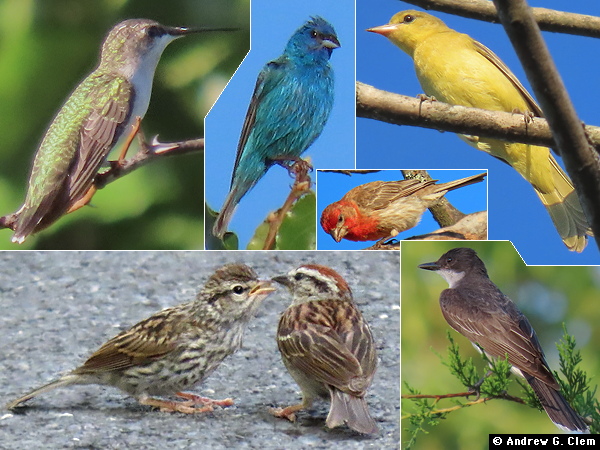
Primary colors! (Bell's Lane, July 28, 2025.)
Additional photos and montages, including individual photos of some of the birds in the above montages, can be seen on the Wild Birds chronological (2025) page.
August 2, 2026 [LINK / comment]
Birding in Virginia, June 2025
Here goes yet another valiant effort to get caught up with blogging about my birding activities last year! As usual, the text is based largely on Facebook posts I was making at the time...
June 4: I got another "primary color trifecta" while hiking and birding with Jacqueline along the Falls Hollow trail around the middle of the day. I finally got my first photo of a Black & White Warbler of the year, along with a Hooded Warbler, Worm-eating Warbler, and Ovenbird. Other highlights included Scarlet Tanager, Blue-headed Vireo, Red-eyed Vireo, Indigo Bunting, and Acadian Flycatcher. Beautiful! We also heard but didn't see a Wood Thrush or two. In addition, Jacqueline was delighted to see a Baltimore Oriole as we were passing through the village of Westview, but my eyes were on the road.
June 7: I joined an Augusta Bird Club field trip to Highland County led by Allen Larner, with only one other member (Scott Priebe) showing up. We met with four birders from Fredericksburg at Bramble Hill, as the property once owned by the late Margaret O'Bryan is known. While everyone else was occupied elsewhere I located a pair of Golden-winged Warblers, the first ones I have seen in a few years! I don't recall ever seeing a female before, and this one was gathering nest material. The other highlights were Black-throated Blue, Canada, Magnolia, and Chestnut-sided Warblers, among some more common ones. We saw a Bobolink at the Blue Grass cemetery, and a Least Flycatcher at the Straight Fork meadow, along with an Alder Flycatcher which I only glimpsed. A Bald Eagle was north of Blue Grass, a Scarlet Tanager (F) was near Laurel Fork, and a Yellow-bellied Sapsucker was near the West Virginia border. We saw both a male and female of that species in fairly close proximity. Allen and Scott tabulated 71 species altogether.
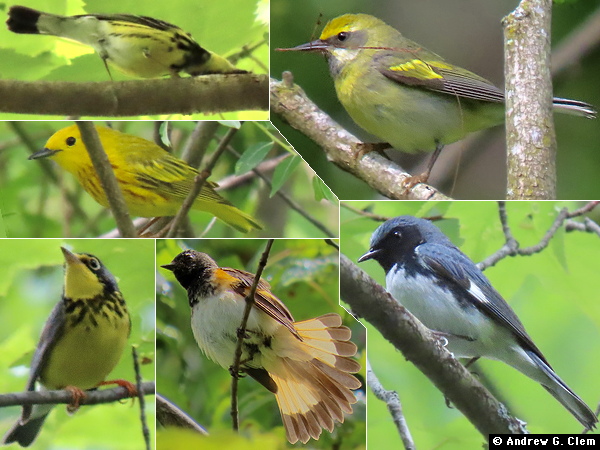
A rare Golden-winged Warbler (F), carrying nesting material, along with other five other warbler species (all male). (Highland County, June 7.)
June 10: I was passing through the Shenandoah National Park on the way back from Dulles Airport (!), and wouldn't you know it, I scored another "primary color trifecta": Indigo Bunting, Scarlet Tanager, and Common Yellowthroat! These photos were taken at various overlooks in the central portion of the park, but mostly along the Pocosin Cabin trail. Cerulean and Chestnut-sided Warblers were every which way! Of note, I saw my first Rose-breasted Grosbeak of the year, a female.
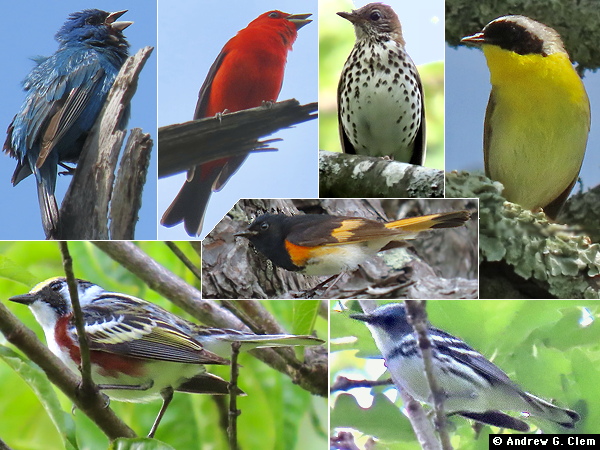
Primary colors! (Shenandoah National Park, June 10.)
June 14: After the menacing clouds lifted early in the evening, I went for a walk along Bell's Lane. Right away I heard that Yellow-billed Cuckoo again, and this time I got a nice closeup view! Near Cujo Corner were a few Cedar Waxwings, and at the high point I heard the distinctive song of an Orchard Oriole. Soon I got a nice view of a first-year male, and he flew to another tree where an Eastern Kingbird happened to be perched. Nice combination shot!
June 21: I had another primary color "trifecta," at three different locations: by the construction site along Barterbrook Road (where the new bridge over I-81/64 recently opened), at the gate in front of Shenandoah Wetlands Bank (south of Stuarts Draft), and near the dam in front of Coles Run Reservoir in the Big Levels area. On the way, I stopped at the Cheese Shop to get some goodies and to see the Purple Martins for the first time this year. The Scarlet Tanagers were mating, so there may be some babies in the Coles Run area in a few weeks!
June 23: Bill Benish, Ann Cline, and I went on an "impromptu" sort of field trip today, hiking over four miles total along the Shenandoah Mountain trail south of the Confederate Breastworks. (We were thoroughly exhausted.) Nearly all of the target birds graciously made appearances; see the caption below. We also saw a Worm-eating Warbler, Red-eyed Vireo, a Veery, some Dark-eyed Juncos (at the high point of our hike, where we turned around), and a Pine Warbler. We also glimpsed one or two possible Ruffed Grouses and heard some Indigo Buntings, Eastern Towhees, and a Red-breasted Nuthatch. Missing in action: Hooded Warbler. All in all, nevertheless, a truly memorable day.
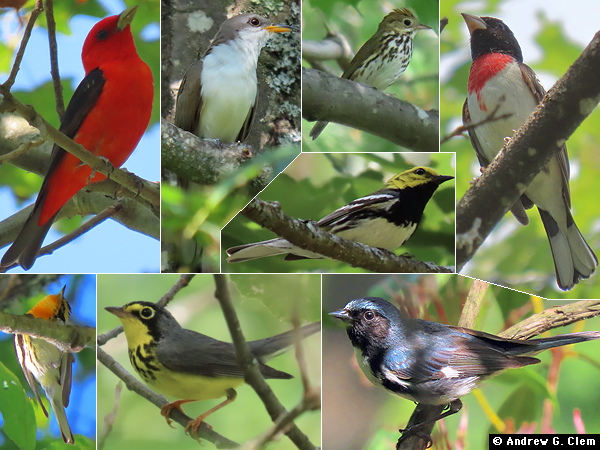
(CLOCKWISE FROM TOP LEFT) Scarlet Tanager, Yellow-billed Cuckoo, Ovenbird, Rose-breasted Grosbeak, Black-throated Blue Warbler, Canada Warbler, Blackburnian Warbler, and (CENTER) Black-throated Green Warbler. (Shenandoah Mountain trail, June 23.)
June 28: I explored the Ramsey Draft are on the western edge of Augusta County, and achieved both of my objectives, in both cases with fledglings being fed by their respective parents. First, the Blackburnian Warbler, which are usually found high up in trees where it is difficult to see. This time they were right at eye level, thanks to the fledglings, who needed to be fed. It was the closest I had ever seen a Blackburnian Warbler, and I was thrilled to get such good photos. This was right next to the bridge over the stream immediately adjacent to the picnic area. Too bad the father (which has much brighter colors) wasn't there! Second, some Northern Parulas, which were my first ones of the year. Nearby were a Louisiana Waterthrush, Worm-eating Warbler*, and several Black & White Warblers. I also heard an Ovenbird and Wood Thrush in the vicinity. I then hiked up the Road Hollow trail, but hardly saw any warblers, just a Scarlet Tanager and an Eastern Wood Pewee. It was a truly memorable day!
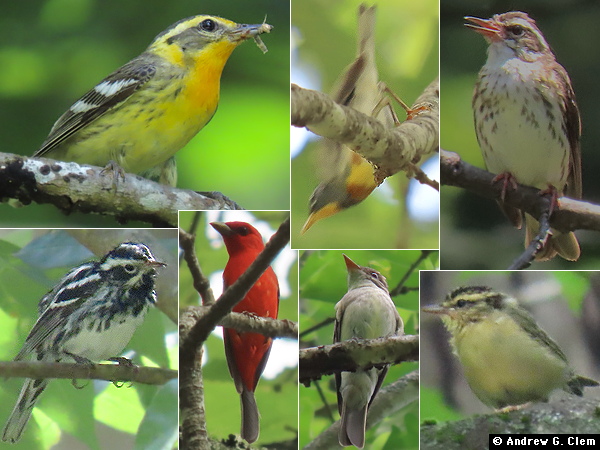
Blackburnian Warbler (F), etc. (Ramseys Draft, June 28.)
NOTE: Three of my Blackburnian Warbler photos, including two with a fledgling that confirms that breeding has occurred in that location, are included on the Virginia Bird Atlas!
Additional photos and montages, including individual photos of some of the birds in the above montages, can be seen on the Wild Birds chronological (2025) page. (NOTE: I incorrectly wrote "2024" in the note at the end of the July 24 blog post, but the link itself takes you to the correct set of photos.)

 To see previous blog entries, go to the Wild Birds archives page.


