


 (all categories)
![[Valid RSS]](Art/valid-rss.png "Validate my RSS feed")
 (baseball)
October 3, 2026 [LINK / comment]
The 2026 postseason is underway!
At home in Atlanta two nights ago, the Braves won their first postseason series since they won the World Series in 2021. They had the momentum from the first inning, when Michael Harris hit a 3-run homer that just barely cleared the high wall in right field. The visiting Phillies just couldn't get anything going, as the Braves' starting opening pitcher Ray Kerr, who had only 9 appearances as a reliever during the last two months of the season, only gave up one hit in 3-plus innings. Final score: Atlanta 6, Philadelphia 2.
This came a day after the Phillies pulled off a stunning comeback win to stay alive in the NL Wild Card Series, powered by back-to-back homers by Kyle Schwarber and Bryce Harper in the 8th inning, tying the game. Alex Bohm's solo homer in the 10th inning proved to be the deciding play of the game. And that, in turn, came a day after the Braves pulled off a stunning comeback win thanks to a 2-out, 3-run homer by Austin Riley in the bottom of the 8th inning. Amazing twists of fate in back-to-back games!
But that was the only Wild Card Series that went a full three games. In San Diego the Padres dominated the Chicago Cubs in both games, in New York the Yankees likewise dominated the Boston Red Sox, while in Houston the White Sox spoiled the Astros's hopes of reestablishing themselves as a serious postseason competitor, defeating the home team twice. It was the first postseason series win by the White Sox since they won the World Series in 2005, and some people suspect Chicago native Pope Leo as the reason for the Southsiders' miraculous upturn from their recent cellar-dwelling ignominy. It was Houston's ninth consecutive loss at home in a postseason game, dating back to Game 2 of the 2023 ALDS, which the Minnesota Twins won. (The Astros ended up winning that series but then lost to the Texas Rangers in the NLCS, in which all seven games were won by the visiting team, just like the 2019 World Series!)
So now the Braves head to Los Angeles to face the Dodgers, who are seeking their third straight World Series title but are perhaps less dominant than what we have become accustomed to. The Padres travel to Milwaukee, where the Brewers hold the highest winning percentage (.636) in all of baseball. The White Sox will challenge division rival Guardians in Cleveland, but given their modest regular-season winning percentages, whoever wins that series probably won't make it beyond the next stage. Finally, the Yankees will play the Tampa Bay Rays in St. Petersburg, hoping that Aaron Judge will be cleared to play. The Rays and the Brewers have the highest winning percentages in their respective leagues, and I'd be happy to see those two teams play each other in the World Series, since neither of them has ever won the Fall Classic. (See the soon-to-be-updated Postseason chronology page.)
Nationals' promising season ends on an upbeat note
After a miserable stretch early in the month (winning on September 1 and then losing the next seven games), the Washington Nationals redeemed themselves with four straight series victories, not including a 1-1 split with the Phillies on the 15th and 16th of the month. On September 11, the somber 25th anniversary of the 9/11 terrorist attacks, the battered and bruised Nationals returned home to D.C. Cade Cavalli was pitching, and had another splendid outing, going 6 innings, but didn't get credit for the win. The crucial play of the game came in the 8th inning: a 2-run single by Jorbit Vivas. The Nats won it, 4-3. On Saturday, Andrew Alvarez pitched 7 shutout innings, but Brad Lord and Will Dion gave up a total of 5 runs in the 8th and 9th inning, and the Nats were lucky to tie it in the bottom of the 9th, thanks to a clutch RBI single by Andres Chaparro, and then they scored in glorious walkoff fashion on an E-6. The Nats also won the Sunday game by the same score (6-5), and to the surprise of many, they swept the Los Angeles Angels.
After resting on Monday the 14th, the Nationals pulled off a minor miracle by beating the Philadelphia Phillies, as rookie pitcher Jackson Kent went five innings without giving up a run. Home runs by Andres Chaparro and Daylen Lile powered the 6-3 win. But the Nats fell flat the next day, relying on recently called-up rookie pitcher Jared Simpson, who only got one out before being relieved in the 1st inning. He was lucky the Phillies only scored 2 runs that inning. What is notable about that game is that the Nationals pitchers walked a total of 13 batters, and yet the Phillies only scored 3 runs total.
After another day of rest, the Nats began a road trip to St. Louis on the 18th, and this time Cade Cavalli got the win, his 13th of the season. That put him ahead of Foster Griffin, who had won 12 games with the Nats before he was traded to the Cleveland Guardians on August 3. He chalked up another milestone, striking out his 200th batter of the year, becoming the first Nationals pitcher to reach that level since Stephen Strasburg (251), Max Scherzer (243), and Patrick Corbin (238) did so in 2019. The Saturday game was notable for having TWO blown saves by the Nationals pitchers (Erik Tolman and Riley Cornelio), wasting yet another fine start by Andrew Alvarez. But this time the Nats batters got in together, winning 8-5 in 11 innings. Any hopes for another sweep faded as the bullpen faltered once again, giving up 3 runs in the bottom of the 8th inning, and the Cardinals won it, 5-3.
Then the Nationals flew to Detroit, where they were beaten by the Tigers, 9-2. Starting pitcher D.J. Herz took the loss, but reliever Luis Perales gave up another 5 runs, putting the game out of reach. The next day the Nats bullpen pitched for the whole game, and somehow kept things under control while C.J. Abrams homered twice (#32 and #33), as the Nats prevailed, 3-1. The series ended in the Nats favor with a 4-2 score, with a home run by rookie Yohandy Morales providing the critical margin of victory.
After another day of rest (the Nats had no Thursday games for the entire month), the Nats returned home for crucial showdown with the New York Mets. At stake was not the division title or a postseason berth but rather avoiding last place at the end of the season. Everything depended on the first game, since Andrew Alvarez was pitching, and Cade Cavalli was already "on vacation" after his triumph on September 18. It was a close, tense matchup, and the Nats ended up with a 7-6 victory, thanks in no small part to a solo homer in the 7th inning by Dylan Crews. That win put the Mets 3 games behind the Nats in the NL East standings, clinching 4th place for the Nationals. On Saturday Connelly Early (acquired from the Red Sox in a late July trade for Curtis Mead) pitched for the first time, and did just fine for 3 innings. Then Jake Irvin came in, but he evidently started to tire by the 7th inning, when the Mets scored 4 runs. The final score was 7-1, but the loss was of no real consequence to the Nats. In contrast, the final game of the season, on Sunday September 27, was symbolic in multiple ways. The Nats did win it, confirming yet another series victory and ending the month with an even 11-11 record -- much better than their 11-13 record in June or their 11-18 record in July! Numbers aside, the fact that the Nationals won their very last game of the season, as well as their very first game back on March 26 (vs. the Cubs), indicates a certain psychological momentum as the team's lengthy "rebuild" finally seems to be paying off.
Nats put up BIG batting numbers
Most baseball writers picked the Washington Nationals to finish in last place in the National League East Division, so it was a clear accomplishment that they exceeded expectations by finishing fourth, ahead of the Mets. Also notable for most of the regular season was the fact that the Nationals led the majors in most offensive categories, including home runs, RBIs. That was mainly a reflection of the depth of the Nats' lineup rather than outstanding individual accomplishments. As a team, the Nats finished third in RBIs, with 777, behind the Chicago Cubs and Milwaukee Brewers, and sixth in home runs, with 210. C.J. Abrams finished the season with 106 RBIs, ten behind the MLB leader Alec Burleson. He led his team in that category and in home runs, with 33. James Wood had been the team leader in homers until August, when he went on the injured list for a few weeks. It is just astounding that Wood did not hit a single home run after July 26, when he (as well as C.J. Abrams) hit two of them! (See the soon-to-be-updated Washington Nationals page.)
Nuñez is #1 in MLB stolen bases!
As for other offensive categories, Nationals infielder Nasim Nuñez was the major league champion in stolen bases this year, with 49. The runner-up in that category was Chandler Simpson of the Tampa Bay Rays, with 46. Nuñez set the record for the Nationals dating back to the team "rebirth" in 2005, but several Montreal Expos players such as Tim Raines racked up substantially higher stolen base numbers during the years prior to 2005. Three years ago C.J. Abrams led the Nats with 47.
Congratulations, Nasim!
Nats make a big deal with Cavalli
Just before he made his final start of the year on September 18, the Nationals signed their quickly-rising ace pitcher Cade Cavalli to a four-year contract, from 2027 through 2030, with a club option for a one-year extension. That was very encouraging, especially in the wake of trading away Foster Griffin, Luis Garcia, and Curtis Mead in July and early August. The Nats front office needs to do likewise with James Wood and C.J. Abrams if they want to establish the team as serious postseason contenders in the years to come. That way they could hope to attract a big name pitcher (or two), which the team so desperately needs. In retrospect, the acquisition of free agent Jayson Werth in December 2010 was the big turning point in the team's history. After that, people began to take the Nationals more seriously, and in 2012 they began their memorable series of postseason runs that ultimately climaxed with the 2019 World Series championship.
Perhaps as a reward for his superb performance, Cavalli was given the rest of the season off. He achieved the Nationals' best records for all three of the major pitching categories: ERA (3.02), Wins (13), and Strikeouts (200). Foster Griffin, the Nationals' best pitcher until he was traded in late July, had 12 wins with the Nationals but just 3 more with the Cleveland Guardians. His ERA with the Nats was 3.06 but 5.79 with the Guardians. Hopefully he'll get a chance to prove himself in the ALDS between the Guardians and the White Sox.
New name for Comerica Park
There was a big announcement as the Nationals began their series in Detroit on September 21. Effective next year, Comerica Park will officially be renamed "Fifth Third Park," under the terms of a contract with Fifth Third Bank. This is not to be confused with Fifth Third Field, the home of the Toledo Mud Hens since 2002, located about 70 miles to the southwest. The first time I heard that name several years ago, I thought it was a joke, but it is indeed real. In anticipation of that change, I updated the Stadium names chronology page.
Minor league ballparks, etc.
I was in the Washington area on September 12, but really didn't have enough time to see a Nationals game that day. (That was when they beat the Angels in extra innings after two blown saves by the bullpen, which would have been hard to stomach.) I did, however, make a stop at Pfitzner Stadium, the former home of one of their farm clubs (single A), the Potomac Nationals. It is located in Woodbridge, Virginia, but has not had any minor league use since that team moved south and became the Fredericksburg Nationals in 2021. As you can see, Pfitzner Stadium is rather plain by contemporary standards. But many prominent former Nationals players, including Ryan Zimmerman and Stephen Strasburg, called this place home at the beginning of their baseball careers.
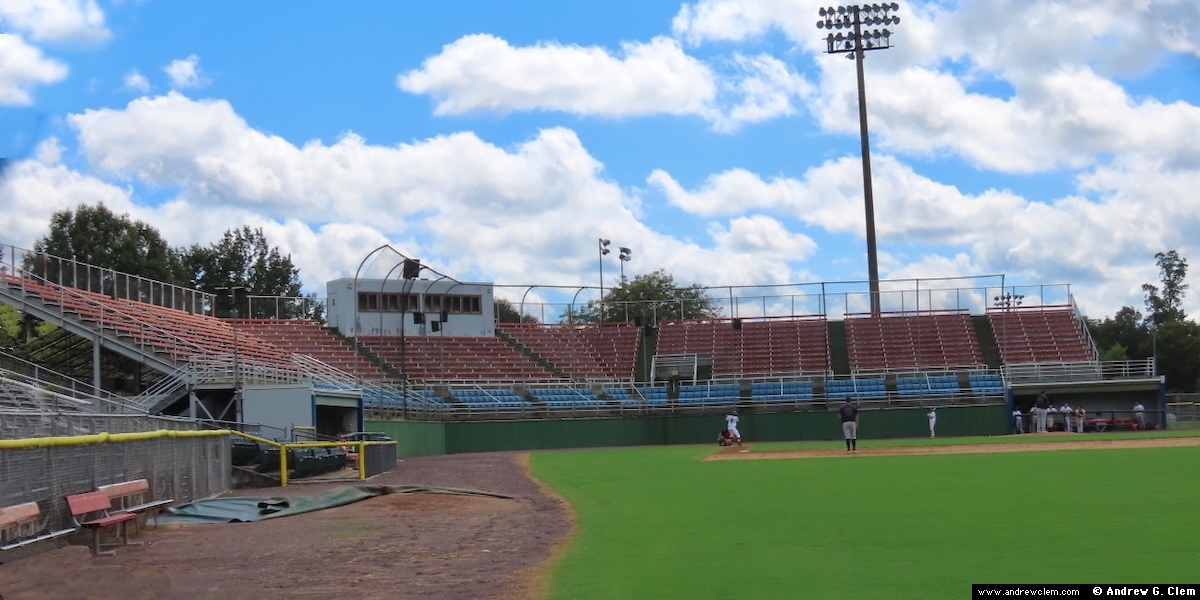
Pfitzner Stadium, former home of the Potomac Nationals, in Woodbridge, Virginia on September 13.
More recently, I paid visits to two other minor league ballparks elsewhere in Virginia, and I will present photos of them in the near future. Since I have no intention of creating separate stadium pages for minor league ballparks, I will eventually create a single page to make it easier to access photos thereof.
Finally, I recently tweaked the Stadiums in Limbo page, taking into account the demolition of RFK Stadium, as well as the Postseason scores page, just in time for the 2026 postseason. The latter page now includes the complete "scoreboard" for the various series that will be played over the next month. If the World Series goes all the way to Game 7, that would take take place on Halloween -- the first time. BOO-OO!) In none of the last three World Series when that possibility existed (2004, 2013, and 2018) did it go past Game 6. In 2017 and 2025, Game 6 of the World Series was played on Halloween. Other years in which World Series games were played on Halloween include 2009, 2010, 2015, 2021, and 2023. I'm pretty sure the the World Series has never ended on Halloween. And, for the record, I am firmly against playing baseball in November, or in March, for that matter, except in extraordinary circumstances such as an earthquake. (San Francisco-Oakland, 1989!)
 Complete blog entries for the current month:


