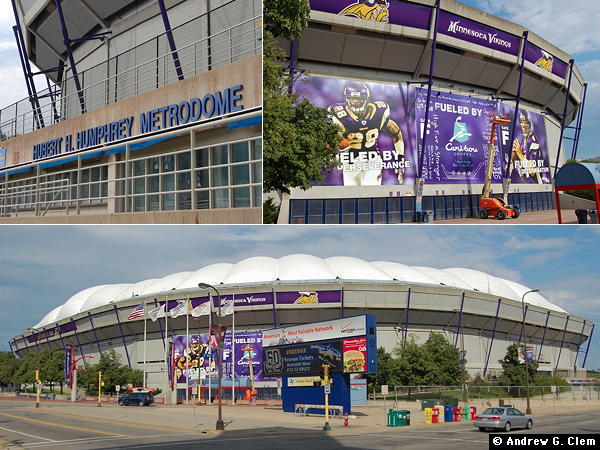
Photos below!
ALL STAR GAME: 1985 ARTIFICIAL TURF: ever since 1982
WORLD SERIES: 1987, 1991 SUPER BOWL: 1992 NCAA basketball Final Four: 1992, 2001, 2006
BEEN THERE: August 1, 2010; brief glimpse in mid-1987.
It may have seemed like a good idea at the time, but the Twins came to regret leaving Metropolitan Stadium to accommodate the Minnesota Vikings' desire for a "modern" all-weather football stadium. The soulless Metrodome was the first major league baseball stadium to feature an air-supported roof, an economical innovation that several universities in northern states had pioneered in the 1970s, the DakotaDome being a prime example. (Heavy snow caused the roof to collapse in the fall of 1982, and again in December 2010.) The apex of the roof at the Metrodome was only 186 feet high (only Olympic Stadium had a lower roof), and batted balls actually struck it a few times. One time Dave Kingman hit a ball right through a hole in the roof, but only got credit for a ground-rule double.
Of all the dual-use stadiums that were built during that era, the Metrodome was probably the least well suited for baseball. (With a rounded rectangular shape, however, it was not really a "cookie-cutter.") From the players' point of view, the original "Sport Turf" surface was very hard, resulting in huge bounces and several knee injuries. It was replaced by Astroturf in 1987, a slight improvement, and by the somewhat more naturalistic "Astro Play" in 2004. Also, it was hard to see fly balls against the backdrop of the fabric roof, much like at the Astrodome before the roof glass wanted painted over. The confined closed arena created loud echoes, which became a famous (and controversial) home-field advantage: Crowd noise!!! Because it was primarily designed for football spectators, the curvature of the stadium's "corners" increased gradually to a sharp bend; there were not a circular arc. Consequently, the backstop was not perpendicular to the line from the pitcher's mound to home plate, so wild pitches tended to bounce toward the right side dugout. A large proportion of the seats were pointed away from the diamond, were too far from the diamond, or (in the upper deck) lacked any view of right field, where the retractable lower deck used for football games was located. For some reason, there was very little "overhang" between the upper and lower decks -- about four rows, much like Atlanta-Fulton County Stadium or U.S. Cellular Field.
Speaking of overhang, the upper deck extended for a few feet over right field (though not nearly as much as at Tiger Stadium), making it necessary for the right field foul "pole" to lean forward to meet with the front edge of the upper deck. Instead of a normal, rigid foul pole, large strips of yellow fabric were suspended from the roof in each corner. This method made the switch between baseball and football easier, and was later used at Skydome / Rogers Centre in Toronto.
The one design "concession" to baseball was the recessed perimeter in the corner of the stadium where the diamond was. This made it possible to have reasonable outfield dimensions in a modest-sized football stadium, and it brought the field closer to the seats along the foul lines. There was a big downside, however: The seats in back of home plate were more than 15 feet above the ground, which detracted severely from the baseball experience. After 1992, Olympic Stadium had a similar backstop with a high wall. When watching a game on TV and the center-field camera is on, you wouldn't see cheering fans, but rather a strange dark wall with two huge grated ducts through which air is pumped in to keep the roof up. (Some say those air currents give a boost to fly balls, which is why this place became known as the "Homerdome.") To cut back on all the home runs, in 1983 the Twins installed a plexiglass shield on top of the left field fence, which probably seemed normal to most fans in Minnesota, where hockey is the biggest winter sport. The plexiglass was removed after the 1993 season. In 1985 they put up a 23-foot high canvas "wall" in right field which became known as the "Hefty bag." The center field fence is just canvas, and outfielders chasing fly balls can bend it a couple feet or so.
 The shape of the field itself -- as opposed to the overall structure -- at the Metrodome was quite similar to the Kingdome, though not with such short outfield dimensions. Fans can access the stadium at either the lower concourse (main level), in the rear of the lower deck, with gates at the four (rounded) corners, or else at the upper concourse, with gates along each of the four sides. The concourses are renowned for being too narrow to accommodate large crowds. There was one quite positive aspect of the Metrodome: its location in beautiful downtown Minneapolis, just a few blocks from the banks of the Mississippi River.
After moving into their new home in 1982, the Twins learned to take advantage of their artificial climate-controlled environment. The high-decibel indoor-amplified cheers were a key part of the Twins' first-ever World Series in 1987, when they beat the St. Louis Cardinals. In terms of franchise history, it was only the first world championship since the Washington Senators won in 1924. Additional seating sections were opened for baseball use in 1989, raising the capacity by about a thousand. The Twins won a second world championship in 1991, beating the Atlanta Braves. The big hero both times was slugger and daredevil outfielder Kirby Puckett, who won a place in Minnesotans' hearts, and eventually an invitation to Cooperstown. (News of his death in March 2006 came as a sad shock to Twins fans.) In 1994 the "dugouts" (within a foot of field level, with seats on top, like at Jack Murphy Stadium and a few others) were moved forward, creating space for three more rows of box seats.
CINEMA: The Metrodome was featured in the motion picture Little Big League (1994).
During the 1990s, however, the Twins' fortunes began to decline, and attendance dropped as the novelty of indoor baseball wore off. In 1996 the Twins followed the example of other teams by closing off a large portion of the upper deck, hanging a big curtain with huge images of great Twins players from years past. This reduced the baseball capacity to less than 49,000. The Twins were becoming desperate to get state funding for a new baseball stadium, but the election of Jesse "The Body" Ventura to be governor in 1998 cast doubt on any subsidy. Franchise owner Carl Pohlad became so despondent that he offered to sell out his franchise as part of Bud Selig's contraction proposal in late 2001. After the Twins' future was secured, negotiations resumed, and after a series of hair-raising ultimatums and rejections, the Minnesota legislature finally passed the necessary funding measure in May 2006. The new stadium, Target Field, was virtually completed by the end of the 2009 season. This was when the Twins beat the Detroit Tigers in a tie-breaker game to take the American League Central Division title, making it to the postseason for the fifth time this decade. Attendance was 54,018, a record for baseball games in the Metrodome. (They lost to the Yankees in the ALCS.)
The Minnesota Vikings, who went to the Super Bowl four times during the 1970s (losing each time), did not fare as well after they moved into the Metrodome. They won a number of divisional titles, but only twice did they reached the NFC Championship game -- in 1998 and 2009 -- and both times they lost in overtime. Seating capacity for football games at the Metrodome was about 64,000. One of the goal lines coincides exactly with the right side foul line, from which we may deduce that the space beyond the north end zone is 13 or 14 feet, given that the distance to the left field corner is 343 feet. (343 - X = 330) There is about eight feet more space beyond the south end zone. The original outfield distances were (supposedly) one foot different, perhaps due to measurement error. The Metrodome was also home to the NBA Minnesota Timberwolves during their inaugural season (1989-1990). In only two other stadiums did an NBA team share a home field with a major league baseball team: Skydome (Rogers Centre) and Kingdome.
In May 2012, the Vikings finally succeeded in getting public funding to build a replacement for the Metrodome, built on the same site. The Vikings played at the University of Minnesota's new TCF Stadium for two years during construction of their new home, U.S. Bank Stadium. One of the alternative stadium proposals was to tear out the entire eastern side of the Metrodome, extend it by about 150 feet toward the east, lower the field and rotate the gridiron by 90 degrees, while adding another level of skybox suites.
For two years after the Twins left, the University of Minnesota Golden Gophers continued to play baseball in the warm confines of the Metrodome, while their new home was under construction. Siebert Field was completed in late 2012. It features aftificial turf ("Mondo Sports Turf"), and has a seating capacity of 1,420.
Within weeks of the Vikings' final game at the Metrodome (December 2013), demolition work began. By the end of February 2014, all that remained was scattered heaps of rubble, as the foundation for the new Vikings' stadium was laid.
SOURCES: Lowry (2006), Pastier (2007), Gershman (1993), USA Today / Fodor's (1996), Rosen (2001); baseball-fever.com; cooloftheevening.com
FAN TIPS: Bruce Orser
| The Clem Criteria: | |||||
|---|---|---|---|---|---|
| Field asymmetry |
Architectural design |
Seat proximity |
Location * | Aesthetics | Overall |
| 4 | 4 | 3 | 7 | 2 | 4.0 |
* See the Stadium locations page.