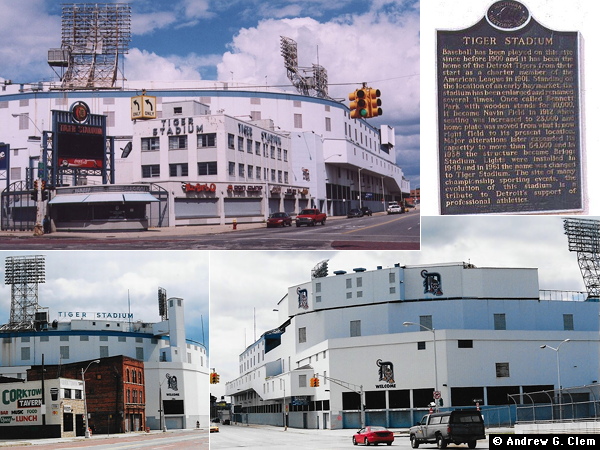
Photos below!
ALL-STAR GAMES: 1941, 1951, 1971 LIGHTS: 1948
WORLD SERIES: 1934, 1935, 1940, 1945, 1968, 1984 (4 W, 2 L)
BEEN THERE: I walked around Tiger Stadium just prior to a Tigers-Rangers game at Comerica Park in August 2004.
Tiger Stadium was not the prettiest ballpark ever built, but it had a lot of unique features and loads of "character." Originally called "Navin Field," it was built on the same plot of land that had been occupied by Bennett Park, a wooden stadium that was built in 1896 and became the original home of the Tigers when the American League was founded in 1901. At first, Navin Field had just a single deck grandstand reaching to the right and left field corners, and a bleacher section in right-center field. In fact, it was like a shrunken version of single-decked Braves Field, except with a roof over the "pavilion" extensions on either side of the main grandstand.
In 1923, an upper deck was added to the main part of the grandstand, from just beyond third base to just beyond first base. From that point until 1926, Navin Field was fairly similar in overall configuration to Sportsman's Park. In 1934, as the Tigers won the American League pennant for the first time since 1909 (the Ty Cobb era), an enormous (though temporary) bleacher section was built along the left field fence, on top of Cherry Street. It was removed after two years. In 1936 the grandstand was extended around the right field corner almost all the way to center field, and The stadium became totally enclosed in 1938, as the grandstand was extended out to left center field, with two decks of bleachers, a unique feature. The bleacher sections extended further to the left side in the upper deck (where the roof ended) and further to the right side in the lower deck. Meanwhile, the ballpark was renamed "Briggs Stadium" after the new franchise owner Walter Briggs III, and very little changed for the rest of its long life.
 There are a few minor anomalies that make this stadium interesting. For example, the diamond is angled about four degrees counter-clockwise relative to the grandstand, which is why the outlines of the quasi-rectangular stadium are not parallel to the foul lines. Whether the field was originally laid out that way, or whether the diamond was rotated in the 1920s, is uncertain. Another anomaly is that the upper deck in right field that was built in 1936 extended ten feet over the outfield field, reflecting the lack of real estate. (This overhang situation also existed in the Polo Grounds.) The upper deck of Tiger Stadium was stacked right on top of the lower deck, with the front edge recessed only about 20 feet toward the back, giving the upper-deck fans an unusually close-up view of the field. In 1955, several rows of seats in the right field corner in foul territory were removed after their star outfielder Al Kaline* ran into the sharp corner that used to exist there. This resulted in another (much smaller) area where the second deck hung out over the field. The center field fence was brought in to 415 feet in 1954 and then moved part of the way back (to 425 feet) in 1955, but the old 440 distance marker they put back on the center field fence was misleading, hence the red border on the "440" marker in the diagram above. Finally, there is a discrepancy over the distance to the backstop: Lowry (2006) gives a figure of 66 feet since 1955 and 54 feet before that, but from looking at aerial photos, I estimate that it was about 60 feet.
CINEMA: Briggs Stadium (as it was then known) was featured in the classic movie Pride of the Yankees (1942), starring Gary Cooper as Lou Gehrig and Babe Ruth as himself. Parts of The Stratton Story (1949) were filmed there as well. Tiger Stadium "played the role" of Yankee Stadium -- using some special effects -- in the movie 61* (2001), and (by implication) Wrigley Field in the movie Hardball, starring Keanu Reeves and Diane Lane.
The Tigers often challenged the Yankees for supremacy from the mid-1930s to the mid-1940s, but for the next two decades thereafter achieved relatively little. In 1960, Briggs Stadium was renamed Tiger Stadium, and the new name took hold. The close-in upper decks in the outfield always provided a tempting target for sluggers. Mickey Mantle once knocked a homer over the right-field stands, as did Reggie Jackson in the 1971 All Star game; Harmon Killebrew, Frank Howard, Cecil Fielder, and Mark McGwire all hit the ball on or over the left-field roof. Even as the city of Detroit was smoldering from rioting, the Tigers won the World Series in 1968, thanks largely to Al Kaline's hitting and Denny McClain's pitching. In spite of economic depression suffered by the entire Rust Belt, they did so again in 1984, giving folks in Detroit something to be proud of.
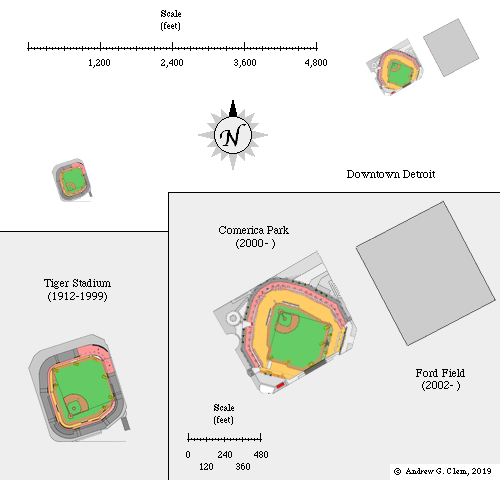
Over the decades, Tiger Stadium deteriorated, as did the neighborhood. As early as the 1960s there were proposals to build a new stadium, but fans (and taxpayers) objected. For a while the Tigers contemplated joining the Detroit Lions in a dual-use domed stadium, which would have been just awful. One option was to build such a stadium on the east side of Tiger Stadium, but the deal with Detroit city officials fell through. The Lions played football in Tiger Stadium from 1938 until the end of 1974, after which they moved into the Silverdome in Pontiac, a suburb over 30 miles away. The only major changes during the latter decades were the closure of the "skybox" suites that perched on the front edge of the roof, and (in 1978) the replacement of the old dark green seats with blue and red ones, the latter being closer to the field in the upper deck and costing more.
During the 1990s, as many other cities built stadiums to replace ones that were half Tiger Stadiums's age, the pressure to build a new ballpark in Detroit became unstoppable. As with Fenway Park, there was a citizen movement to save Tiger Stadium, but it failed. In 2000 the Tigers abandoned one of the last three original classic stadiums still in use and moved into Comerica Park.
For the next eight years, Tiger Stadium rusted away in idle "purgatory," as people in Detroit argued about what to do with it. After preservationists were given a deadline for raising the necessary funds, demolition of Tiger Stadium began in July 2008. After about two thirds of the stadium was demolished, workers paused, giving preservationists more time to save what was left of the stadium. In November, a tentative deal was reached between the Old Tiger Stadium Conservancy and the Detroit Economic Growth Corporation, and hopes were high in early 2009. In June, however, city officials lost patience and gave the order to begin final demolition of the remaining portion of the structure. Say what you will about whether Tiger Stadium was worth saving, but the sudden and surreptitious way it was finallly "condemned" by the authorities was quite unjust.
SOURCES: Lowry (2006), Pastier (2007), Gershman (1993), USA Today / Fodor's (1996), Tom Stanton, The Final Season: Fathers, Sons, and One Last Season in a Classic American Ballpark (Thomas Dunne Books, 2001); Ken Burns' Baseball TV documentary series
WEB LINKS: Friends of Tiger Stadium; DetroitYES.com (photos by Lowell Boileau); savetigerstadium.org; PreserveTigerStadium.com; Michigan History magazine; Sports Illustrated-CNN.com (virtual reality), detroitathletic.com.
RESEARCH ASSISTANCE: Bruce Orser
| The Clem Criteria: | |||||
|---|---|---|---|---|---|
| Field asymmetry |
Architectural design |
Seat proximity |
Location * | Aesthetics | Overall |
| 6 | 5 | 7 | 4 | 6 | 5.6 |
* See the Stadium locations page.