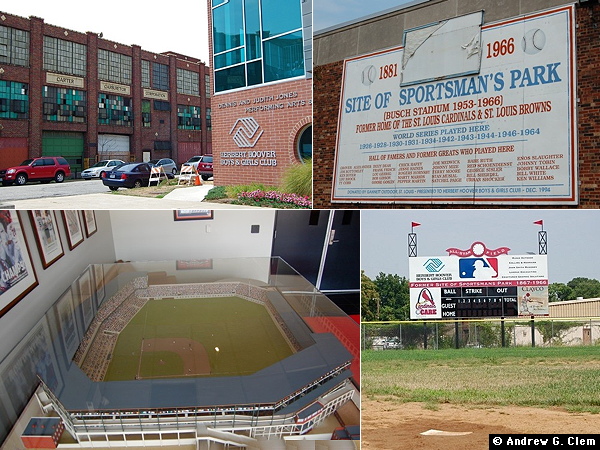
Photos below!
ALL-STAR GAMES: 1948, 1957 "BEEN THERE" (too late): Aug. 17, 2011 LIGHTS: 1940
WORLD SERIES: 1926, 1928, 1930, 1931, 1934, 1942, 1943, 1944*, 1946, 1964 (7 W, 3 L)
* All those years apply to the Cardinals; in 1944 both the Cardinals AND the Browns hosted the World Series here.
Depending on how you define things, this ballpark could be considered to date back to the 1880s, but it was in 1909 that a modern, large concrete and steel structure was first built on this site. Among all the "classic" stadiums of that era, it was probably the dullest in terms of field layout and architectural design. The stadium design was a simple rectangle, much like Shibe Park, but without the stylistic adornments. True, left field was significantly deeper than right field, but the outfield walls were perpendicular to each other. The walls were nearly 12 feet high, more than most other stadiums, which prevented any dramatic lunging catches into the bleachers.
Nevertheless, the evolution of this ballpark was more interesting and even mysterious than most. When the main grandstand was built in 1909, the diamond was moved from the north corner to the west corner of the block, as additional land was acquired on the southwest side. The old main grandstand, a single-decked roofed, was retained as a pavilion in the left field corner. Evidently, part of that pavilion was torn down to create more room in that corner, or else the known dimension data are not consistent with the shape of the field. What had been the bleachers along the third base line and left field became the bleachers in left and right field after the diamond was shifted. New pavilions extending to the left and right field corners were added in 1911, though their exact position is unknown.

Sportsman's Park was home to two major league teams for 33 1/2 years, a longer sharing arrangement than at any other stadium. (See the Anomalous stadiums page. ) It was originally the home of the St. Louis Browns, a second-rate team that usually drew mediocre crowds. In the middle of the 1920 season the struggling St. Louis Cardinals abandoned rickety, wooden Robison Field franchise just a few blocks to the north northwest and arrived in Sportsman's Park as "tenants" on July 1. Soon the new owner, Branch Rickey, created one of the most inspiring rags-to-riches stories in baseball history, building a small empire of minor league clubs he used to groom prospective big leaguers. This was the origin of baseball's "farm system," and other major league franchises soon followed suit in building their own farm clubs. The Cardinals came to dominate the National League, and from 1926 to 1946 they won nine pennants, and in six of those years they emerged as World Series champions! Because of the scruffy appearance of their players during the 1930s, the Cardinals became known as the "gashouse gang." They completely overshadowed their nominal landlords, the Browns, who made it to the World Series only once -- in 1944, when they lost to, of all teams, the Cardinals!!!
CINEMA: Sportsman's Park was featured in the classic movie Pride of the Yankees (1942), starring Gary Cooper as Lou Gehrig. There were fake outfield backdrops in the action scenes, suggesting that these scenes were filmed elsewhere.
In 1926 the second deck was extended on both sides to the left and right field corners. (The edges of both upper decks aligned perfectly with the foul lines!) From just beyond third base to just beyond first base, the second deck extended a few rows beyond the edge of the rooftop. One unique feature was a 33-foot high screen fence that stretched across most of right field, to prevent cheap home runs in that direction. It was attached to the roof of the "pavilion," the upscale bleacher section reserved for negroes (as Blacks were then called) in the days of segregation. (Forbes Field had a similar screen fence in right field for several years.) Sportsman's park finally ended this segregation in 1944, after all other teams had already done so. There was a flag in front of the center field wall and a pub in the triangular corner beyond center field. Guess what kind of beer they served?
In 1951 the St. Louis Browns franchise was purchased by maverick baseball promoter Bill Veeck, the pronunciation of which is specified by his autobiography, entitled Veeck -- As In Wreck. (My dad once had a copy of it.) Veeck failed to revitalize the dreary team, however, and he sold it to Baltimore investors after the 1953 season. In 1954 the team began playing under a new name (the Orioles) at a new home: Memorial Stadium.
After that point, the Cardinals had Sportsman's Park all to themselves, and it was renamed "Busch Stadium" after the team's owner Augustus "Gussie" Busch. (The Phillies did something very similar when they inherited Shibe Park / Connie Mack Stadium from the departing Athletics a year later.) He soon installed a big Anheuser-Busch trademark mechanical eagle that flapped its wings after each Cardinal home run, and had prominent Budweiser advertisements plastered around the stadium; such crass commercialism was typical of many other stadiums in those days, but in a sense, the corporate sponsorship was decades ahead of its time. On positive change was replacing the center field bleacher seats with shrubbery, a sort of natural dark backdrop for batters. The star player for the Cardinals during the 1940s and 1950s was Stan "The Man" Musial.
I remember the World Series defeat (4 games to 3) the Yankees suffered at Busch Stadium in 1964, just two years before the Cardinals likewise departed. Just as they had arrived in the middle of a season (in 1920), their final game here was on May 8, 1966. The Cardinals then moved into the beautiful "New" Busch Stadium, located in downtown St. Louis, and the old "Busch Stadium" was demolished soon thereafter.
SOURCES: Selter (2008), Lowry (2019), Pastier (2007), Ritter (1992), Gershman (1993)
WEB LINKS: The St. Louis Browns Fan Club (defunct), photographs by Bernard M. Waxman (also defunct)
FAN TIP: Charles R. Dodds
| The Clem Criteria: | |||||
|---|---|---|---|---|---|
| Field asymmetry |
Archi- tectural design |
Seat proximity |
Location * | Aesthetics | Overall |
| 6 | 3 | 5 | 5 | 5 | 4.8 |
* See the Stadium locations page. Roll your mouse over the map below to see a closeup of the stadium site today.