

 Photos below!
ALL STAR GAME: 1966 ARTIFICIAL TURF: 1970 - 1995
WORLD SERIES: 1967, 1968, 1982, 1985, 1987, 2004
BEEN THERE: I parked next to the (empty) ticket office and took a peek in August 2002. (See photo below.)
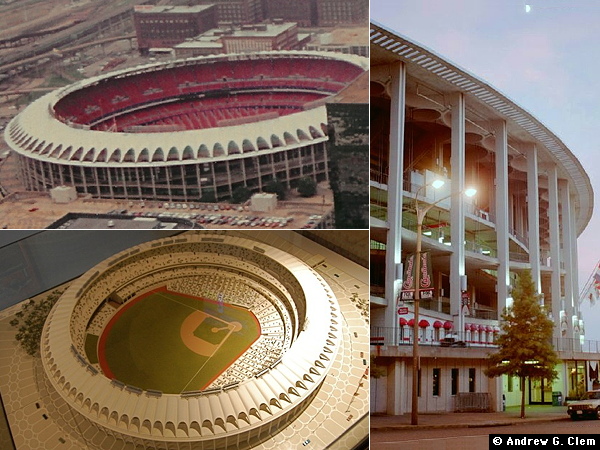
Even before the Cardinals won the 1964 World Series, it was decided that the old "Busch Stadium" (as Sportsman's Park had been called since Anheuser-Busch acquired the team in 1953) needed to be replaced. In 1966 the Cardinals moved into the NEW Busch Stadium, which was a vital part of the urban renewal of downtown St. Louis, shortly after the Gateway Arch was completed. The background scenery of that Arch plus the arch-shaped roof supports around Busch Stadium's exterior distinguished it from all the other anonymous characterless circular hybrid stadiums built in the late 1960s and early 1970s. Another difference from other stadiums of that era was that Busch Stadium's roof covered most of the upper deck; that was appropriate given the hot, steamy summer days in St. Louis.
The original outfield dimensions of Busch Stadium were quite deep, 414 to center field and 386 feet to the power alleys, with a total fair territory of about 116,400 square feet. (Foul territory was originally quite ample as well, about 31,300 square feet.) There were a few adjustments back and forth during the 1970s and 1980s, but the distance to the foul poles remained fixed at 330 feet. There was more foul territory around home plate than is/was the case at most other stadiums with the "paired swivelable circular section lower deck" (PSCSLD) configuration, of which Busch was the third such instance. Originally, the field was grass, with a thin strip of artificial turf parallel to the first base line, concealing the underground roll of tarpaulin, similar to what Forbes Field had in its latter years. It was replaced by Astroturf in 1970, and in 1977 the infield dirt was replaced by Astroturf except for around the bases. The artificial surface often raised the temperature on the field by ten degrees or more.
One of the most successful medium-market baseball franchises ever, the Cardinals won the World Series one year after moving into their new home, and did so again in 1982. During the 1980s shortstop Ozzie Smith dazzled crowds with his amazing defensive plays and exhuberant acrobatics. After St. Louis acquired Mark McGwire from the Oakland A's in mid-1997, the Cardinals began generating excitement once again. The fact that McGwire hit his 62nd and 70th home runs in Busch Stadium in 1998 has endowed this ballpark with transcendent historical significance.

Busch Stadium (II) was slightly elliptical in shape, not circular. The only other cookie-cutter "doughnut" stadiums that shared this characteristic was Three Rivers Stadium in Pittsburgh; Olympic Stadium in Montreal had a very distinct oval shape. Otherwise, Busch Stadium was quite similar in terms of overall layout to the Astrodome, which was circular. In both of those stadiums, the portion of the lower deck between left-center field and right-center field was about 12 feet lower than the rest of the lower deck. Also, at least originally, the foul poles in both stadiums coincided with the edge of the upper (non-rotatable) portion of the first deck. Mark McGwire's 70th home run in 1998 just barely cleared the left field fence, landing underneath the seating section.
The St. Louis Cardinals football team (which had moved from Chicago in 1960, sharing the previous Busch Stadium) played in Busch Stadium II from 1966 until 1987. It was one of only two dual-use stadiums in which no additional seating sections were used during football games, the other being Three Rivers Stadium. That's why football and baseball capacities were essentially the same. In 1988 the NFL Cardinals moved to Phoenix, Arizona -- in search of browner pastures? That put the baseball Cardinals in the same awkward position as the New York Mets after the Jets left Shea Stadium in 1984, or the Oakland Athletics after the Raiders relocated to Los Angeles in 1982. What's the point of a dual-use stadium if it's actually used for only one sport? In response, the City of St. Louis decided to build a new football stadium in hopes of attracting an NFL franchise, and ground was broken at a site on the north side of downtown in 1992. Their efforts paid off in 1995, when the Los Angeles Rams moved to St. Louis. The Rams played in Busch Stadium for the first two months, while construction on the new "TWA Dome" (later "Edward Jones Dome") was being completed. During that time, temporary bleachers were installed in the big open spaces at the four corners of the gridiron.
CINEMA: Parts of Fever Pitch (2005), starring Drew Barrymore and Jimmy Fallon, were filmed in Busch Stadium, during the (real-life!) 2004 World Series between the Red Sox and the Cardinals.
The Beatles played a concert at brand-new Busch Stadium on August 21, 1966, a day after they had played at Crosley Field in Cincinnati.
In both 1987 and 1988, Busch Stadium's capacity was raised by a few hundred. Part of that was accomplished by putting an extra row of seats in certain parts of the lateral aisles in the upper deck. (See the 1987 photo below.) Otherwise, very little changed in Busch Stadium II until 1996, when a major renovation began. With no prospect that Busch Stadium might become a multi-sport venue again, work began on transforming it into a baseball-only facility. Real grass was planted in 1996, and a grassy slope was planted in center field, flanked by new bleachers with actual bench seats. In addition, a new family pavilion and a picnic area called "Homer's Landing" were built behind the new bullpens (which were moved from foul territory to right- and left-center fields), and the formerly curved fence was made straight in front of the bullpens, reducing the power alley distance slightly. (The bullpen in right field was not completed until 1997, so the visiting team used the bullpen in foul territory. For 1996, the distance to right center field remained what it had been, 375 feet.) Finally, four rows of seats were added to the front of the lower decks (no longer "swivelable"), and the portions near the foul poles were rebuilt with the rows of seats angled toward the infield. In 1997 the rarely-occupied rear portion of the outfield upper deck was closed off by the installation of a huge hand-operated scoreboard, video screens, and a row of banners displaying the team's many past triumphs and star players. This reduced the capacity from about 56,000 to about 50,000. (About that time, the Cardinals began including 1,500 standing-room-only in its capacity figures.) In 2000 or so, an extra row of seats was built in front of the "loge" level on either side of the foul poles, overhanging the field by about three feet like a small balcony. In its last few years with lush green grass, Busch Stadium gleamed like it was new, even though it was one of the last of the "doughnut" stadiums.
Construction on the Cardinals' new home, Busch Stadium III, located on the south side of the "old" Busch Stadium (II), began in early 2004. The left field grandstand of the new stadium overlaps with the first base side grandstand of the old stadium. In the last game ever played at Busch Stadium II, on October 19, 2005, the Houston Astros beat the Cardinals, 5-1, earning their first-ever trip to the World Series. That gave construction workers a couple extra weeks to demolish Busch Stadium soon thereafter, so that Busch Stadium III could be ready for Opening Day 2006.
SOURCES: Lowry (1992, 2006); Pastier (2007); Rosen (2003); USA Today / Fodor's (1996)
FAN TIPS: Ian Scott, Jonathan Karberg, James Sutton, Mark London
| The Clem Criteria: | |||||
|---|---|---|---|---|---|
| Field asymmetry |
Archi- tectural design |
Seat proximity |
Location * | Aesthetics | Overall |
| 2 | 5 | 4 | 7 | 6 | 4.8 |
* See the Stadium locations page.


 (Go up.)