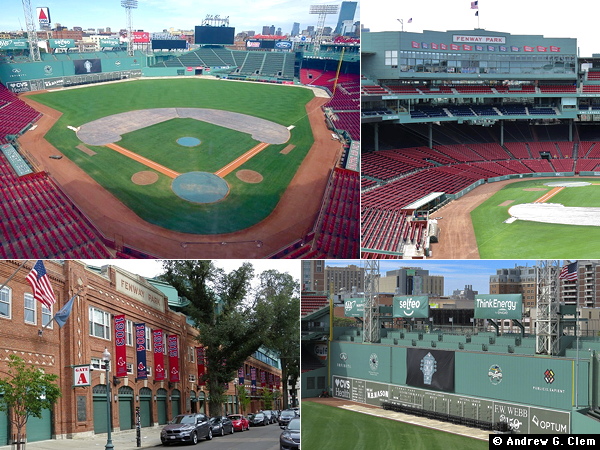
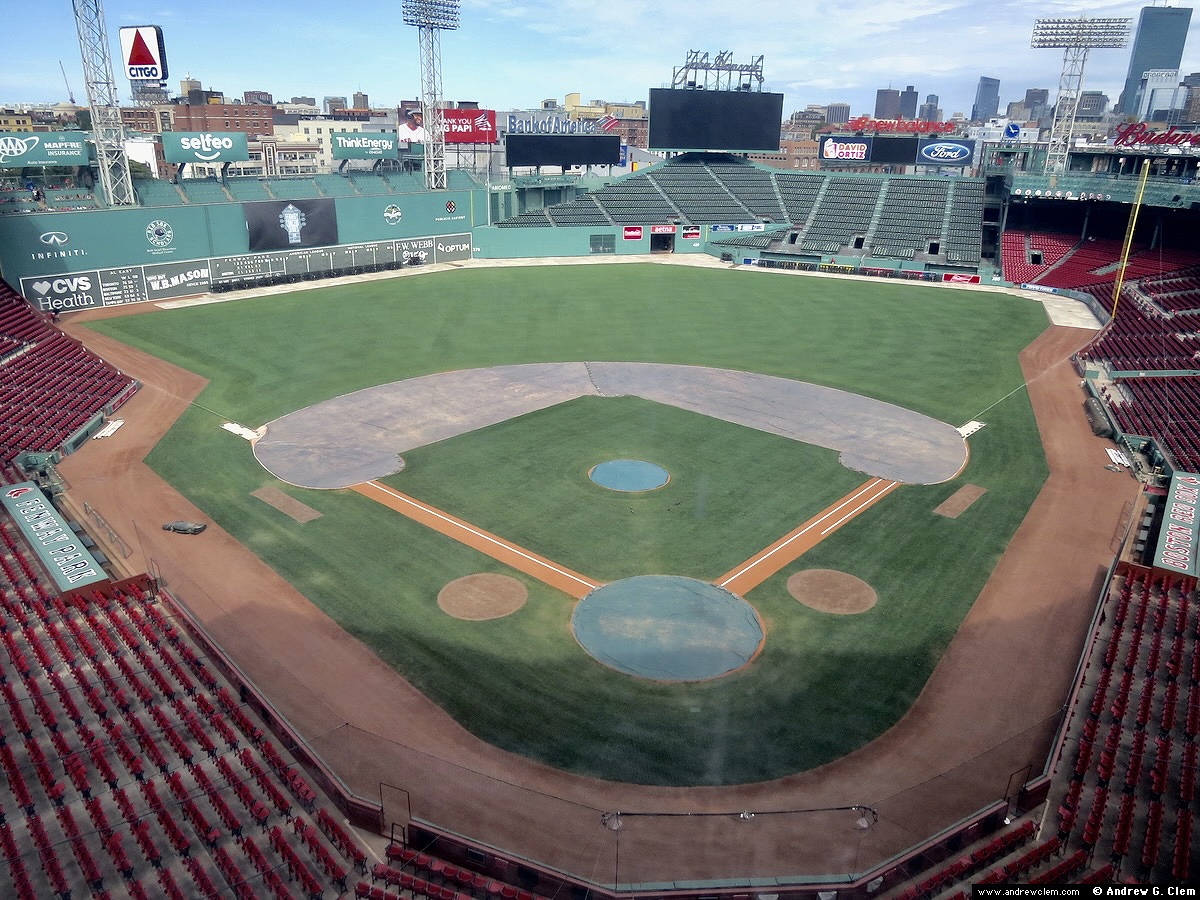
Photos below!
ALL STAR GAMES: 1946, 1961, 1999 LIGHTS: 1947
WORLD SERIES: 1912, 1914**, 1918, 1946, 1967, 1975, 1986, 2004, 2007, 2013, 2018 (7 wins, 4 losses)
** The Boston Braves played in Fenway Park for the 1914 World Series, while the Red Sox played in Braves Field for the 1915 and 1916 World Series.
BEEN THERE, DONE THAT: I walked around the outside of Fenway Park in both 1998 and 2002, and took a guided tour in September 2016.
Fenway Park is the best classic era baseball stadium still standing, falling slightly behind Wrigley Field only in the aesthetics and location departments. It has some of the quirkiest angles and extreme dimensions of any stadium, and the seats are very close to the field, leaving very little foul territory. The way the right field fence angles out sharply from the foul pole to the bullpens creates a unique situation that challenges visiting right fielders to chase down hard-hit line drives that often end up as triples. Center field is unusually short, but the high fence there (18 feet) makes it hard to hit home runs in that direction. Fenway Park is also the only stadium with essentially just one big deck, although . Exhibition Stadium Braves Field. There is a mezzanine level (or levels) for high-paying patrons on top of the roof, but this is only about six rows deep. My first impression (from the outside only; the Red Sox were out of town both times I was there, and there were no tours either day) was that this modest four-story brick structure didn't look big enough to contain a major league baseball stadium.
 In the original configuration, there was a steep slope in left field, known as "Duffy's Cliff" after the Red Sox left fielder. Temporary bleachers were installed along that slope for World Series games. The space behind the center field bleachers was in play for some of the early years, accounting for the outlandish official distance of 550 feet to the corner just right center field. (The 593 foot official distance given for the early 1930s is very doubtful.) Another possible oddity is that the rows in the uncovered section of the grandstand on the third base side were apparently angled toward the infield, not parallel to the front edge, so that the front edge steadily rose in height as it approached the foul pole; if so, the rear edge of that section would presumably be oriented that way as well. (This is based on a wide angle photo from the Burns and Ward book, however, so it may be an optical illusion.) Warning tracks are not shown in the 1912 version diagram above because available photographs do not show any dirt along the fences; further research may be necessary.
The Boston Braves moved into Fenway Park in August 1914 and played the 1914 World Series there, and remained as temporary tenants of the Red Sox until construction of Braves Field was completed in August 1915. Oddly enough, the Red Sox left behind their brand new stadium during the World Series in both 1915 AND 1916, preferring the even newer (and much bigger) Braves Field a few blocks away. (See the Anomalous stadiums page. Boston was totally crazy about baseball in those days, and many people hoped for an all-Boston World Series. That eventuality almost came to pass in 1948, but the Cleveland Indians beat the Red Sox in a tie-breaking playoff game, thus winning the American League pennant.
In 1926 two alterations took place. First, the dimensions changed in all directions: right field rose sharply, center field shrank signficantly, and left field was reduced slightly. Evidently, the diamond was moved a few feet forward and to the right, and rotated about two degrees counterclockwise. (This is a conjecture on my part based on the data given in Lowry's Green Cathedrals; the center field distance of 426 feet is not consistent with the other dimensions, however. I estimate it would be 436.) Also, the odd-shaped wooden bleachers near the left field corner burned to the ground, and were replaced by much smaller bleachers, in a normal rectangular shape.
Fenway Park was substantially rebuilt in 1934, with new bleachers and new grandstands in the right field and left field corners. The steep slope in front of the left field wall was eliminated, while the wall was raised from 31 feet (including six feet of slope) to 37 feet in height. This created the signature feature of Fenway Park that almost everyone who pays any attention to baseball recognizes: the famous "Green Monster." Originally it was plastered with advertising billboards, and didn't really turn "green" until 1947. Another intriguing aspect of this quirky ballpark is the uncertainty over the true left field dimension. Officially it was 315 feet from 1936 on, but blueprints and independent estimates suggested 308 feet or less. In 1995 the Red Sox changed the distance marker from "315" to "310."
In 1940 the bullpens were moved from along the foul lines to in front of the right field bleachers, which shortened the distance out there by about 23 feet. This area of the ballpark was known as "Williamsburg" after the Hall of Fame slugger Ted Williams, who hit 521 home runs in his career, tied with Willie McCovey for 12th place all time. If Williams had not served his country in the armed forces in two wars -- World War II and Korea -- he would almost certainly have hit at least 100 more homers, and possibly more than Babe Ruth's lifetime total of 714.
For many years after the light towers were added in 1947, Fenway Park remained virtually unchanged. In 1976, a new electronic scoreboard was added in the rear corner of the bleachers, and about 400 seats were added to the roof near the right field foul pole. During the 1980s a big new multi-level press box/sky box section, known as the "406 Club," was built on top of the roof behind home plate. Also, a second mezzanine level was added around the infield.
CINEMA: Fenway Park appeared in the movies Field of Dreams (1989), Major League II (1994), Little Big League (1994), Fever Pitch (2004), and The Town (2010).
Despite all this charm, for 86 years there was a dark side to Fenway Park, the failure of the Red Sox to win any World Series for over eight decades after 1918: the "Curse of the Bambino," as in Babe Ruth. Red Sox fans have endured some of the highest emotional peaks -- such as Carlton Fisk's game-winning home run over the Green Monster in Game 6 of the 1975 World Series -- and some of the bleakest moments of despair -- such as Game 7 of the 2003 AL divisional playoffs when the Red Sox frittered away a four run lead against the Yankees. And then after losing the first three games of the ALCS in 2004, the Red Sox overcame their ill-starred legacy and finally achieved triumph against all odds. "The curse was reversed!" The Red Sox went on to beat the Cardinals in four straight games in the 2004 World Series, and secured three more world championships: in 2007, 2013, and 2018. They won the AL East by a wide margin in 2018, and sailed through the postseason series, beating the L.A. Dodgers in the World Series, in yet another triumph. It's a veritable dynasty.
 The elongated shape of Fenway Park was well suited for football. After spending just one year (1932) in Braves Field, the new Boston Braves football team changed their name to the Redskins (a close match to the name of their new hosts!) and played in Fenway Park from 1933 to 1936, after which they moved to Washington, D.C. The AFL Boston Patriots played in Fenway Park from 1963 until 1968, but then the AFL and NFL merged as pro football grew in popularity, and it became obvious that something bigger was needed. After one year each in Alumni Stadium (Boston College) and Harvard Stadium, they moved into Foxboro Stadium in 1971, becoming the "New England" Patriots.
During the 1990s, discussions about replacing Fenway Park got underway. They wanted to build a virtual carbon copy of the original ballpark next door, complete with a new "green monster" in left field, but with a bigger second deck. The Save Fenway Park citizen movement stoutly resisted the proposal, however. After John Henry bought the Red Sox from the Yawkey family in 2002, it was decided to renovate Fenway Park, which will therefore live on for the foreseeable future. The renovations began in early 2003 by installing a new section of high-priced seats on top of the Green Monster. Since it hangs over the sidewalk (supported by steel beams positioned at a 45 degree angle), they had to get a special easement from the City of Boston. Some purists complained, but it's only three rows deep and really doesn't detract from the classic Fenway setting. In addition, two extra rows of box seats were squeezed in behind the diamond, and a new concession area was added in back of the right field bleachers, where a run-down garage had been previously. Prior to the 2004 a new section of luxury "tavern style" seats was added on top of the roof in the right field corner, adorned with a big "Budweiser" sign in neon lights. The biggest change came in 2006, when the tiny top level was expanded into a real upper deck, albeit a small one. Also, the glass was removed from the former "406 Club" behind home plate, exposing Boston's elite patrons to the chilly air. In 2008, a new section known as the "Coca-Cola Corner" was added to the upper deck in the left field corner, and in 2009 a similar section was added near the right field corner. At some point in recent years, party tables and a stage for musical performances were added to the roof of the adjacent building on the northwest side, and several rows of vegetables were planted to provide the ultimate in fresh food for hungry fans. In 2011, the upper deck was extended about 25 feet to the left field corner, while additional renovations were completed underneath the grandstand. These incremental additions have raised the seating capacity to over 37,000, guaranteeing the Red Sox a big enough revenue stream to remain competitive in future years.
NOTE: The lack of a suitable alternative venue for home games in Boston severely contrained the Red Sox options for renovating Fenway Park. The need to finish any construction over the winter months forced them to make a relatively modest expansion of the upper deck in 2006. But what if the diamond had been relocated in order to make room for a much bigger uper deck expansion? That scenario is envisioned in the "hypothetical" configuration shown above, where home plate is moved to right field, with a 37-foot high fence in the new (temporary) center field. Stadiums in Cincinnati and Anaheim continued to host games during a major construction projects, so it wouldn't be the first time. It is an admittedly far-fetched possibility, and in any event was rendered moot when the upper level at Fenway Park was expanded in 2006, and subsequent years. The "hypothetical" diagram above is presented merely for the sake of amusement.
On January 1, 2010, the annual Winter Classic outdoor hockey match was held at Fenway Park, as the NHL Boston Bruins hosted the Philadelphia Flyers. This event had been held at Wrigley Field the year before. On July 21, 2010 Fenway Park hosted an exhibition soccer match between the Celtic Football Club and Sporting Portugal. It was a very tight squeeze. In November 2018, Harvard and Yale played a football game at Fenway Park, with the gridiron parallel to the grandstand, as was the original intent.
SOURCES: Stout (2011), Lowry (2006), Pastier (2007), Selter (2008), Gershman (1993), Ward & Burns (1994), USA Today / Fodor's (1996), Rosen (2001), Washington Post
WEB LINKS: boston.com, Boston Public Library, zazzle.com
FAN TIPS: Steven Poppe, Howard Corday, Bruce Orser, Sean Holland, A. Young
| The Clem Criteria: | |||||
|---|---|---|---|---|---|
| Field asymmetry |
Architectural design |
Seat proximity |
Location * | Aesthetics | Overall |
| 9 | 7 | 9 | 7 | 8 | 8.0 |
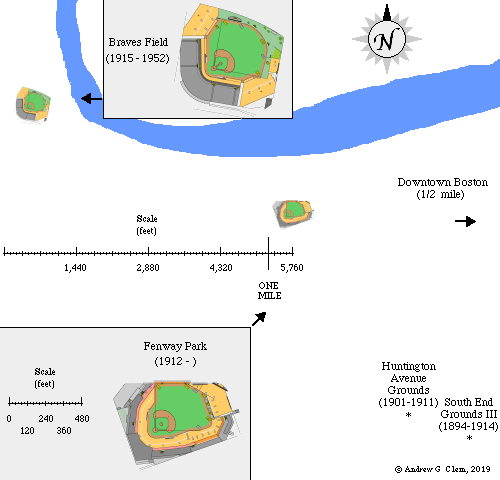
* See the Stadium locations page.
Visit Boston!
As the first major city in the United States, there is a lot of history to appreciate in Boston, from Faneuil Hall to Bunker Hill. The once-derided "dirty water" of the Charles River is now the center of a pleasant recreational area, full of bicyclists and rowers. Beer drinking is considered a patriotic duty by many, hence Samuel Adams brewing. New England lobsters and Dunkin' Donuts are among the culinary specialties.
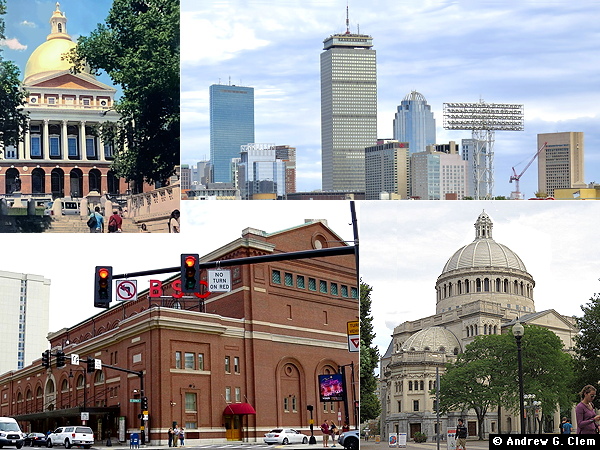
CLOCKWISE FROM TOP LEFT: Massachusetts State House, Boston downtown skyline from Fenway Park, the Christian Science cathedral, the Boston Symphony Orchestra building.