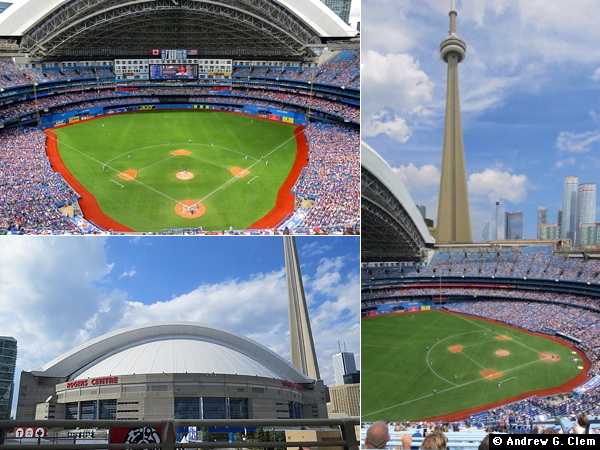
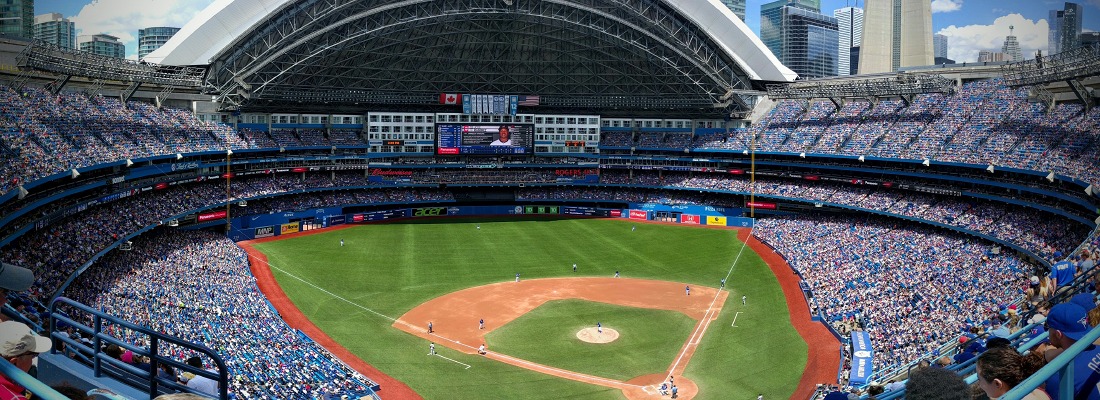
Photos below!
ALL STAR GAME: 1991 WORLD SERIES: 1992, 1993, 2025 (2 wins, 1 loss) ARTIFICIAL TURF: ever since it opened
BEEN THERE, DONE THAT: July 19, 2015 (TOR 4, TB 0); "drive-by" on July 8, 2022
No snow-covered field here! Built at a cost of $578 million (U.S.), Skydome (as it was called originally, without the definite article the) was incredibly extravagant, especially compared to its humble predecessor Exhibition Stadium a few blocks away along the shore of Lake Ontario. The initial results seemed to justify the enormous investment, however. In each of the first four full years it was in operation (1990-1993), Toronto broke the American League attendance record, exceeding the four million mark in the last three of those years! Spurred by all this fan support, the Blue Jays became serious pennant contenders and won the World Series in 1992 and 1993. Canadians were ecstatic. Given this truly phenomenal success, one would have expected the Skydome to pay off rather quickly, but the financial bottom line in the early years actually showed a net loss.
Although Skydome reeked of "stadium socialism," much of its funding came from private sources, as a large number of Canadian corporations made multi-million dollar investments in exchange for long-term skybox contracts. The CN Tower is the tallest free-standing structure on Earth, and the Skydome-CN Tower complex became one of the most distinctive urban signatures in the world. Those landmarks of the Toronto skyline were featured in the Canadian Gothic vampire television drama series, Forever Knight.
Skydome was the last "hybrid" (i.e. dual-use) stadium ever built. Oddly, it was the first such stadium with a functioning "paired swivelable circular section lower deck" (PSCSLD) design since Riverfront Stadium was built in Cincinnati in 1970. (See Stadiums by class: Doughnuts / Cookie-cutters).) Of all the PSCLD-design stadiums, Rogers Centre's lower deck is unique in three ways: it curves slightly, it does not meet flush with a small, fixed-position "loge"-level immediately above it, and it lacks entry portals. Instead, the patrons gain access directly via the main concourse or via a ramp along the rear of the lower deck in the outer sections. These aspects reflect the fact that the front edges of the grandstand decks conform to a rounded rectangle shape, similar to an "octorad." The perimeter of the stadium is actually circular, much like the Superdome. Even including the hotel beyond center field, the structure is at least 50 feet shorter, end-to-end, than Montreal's Olympic Stadium, which had a true oval shape. In terms of height, it was the tallest domed stadium ever built until Miller Park surpassed it in 2001: 330 feet, compared to 310 feet.
 The retractable roof is rather ingenious: It consists of four sections of about the same width, two of which slide along parallel rails. The last section, which covers the seats in back of home plate, is moved in a different fashion, rotating 180 degrees along a curved track on the perimeter of the stadium. The need for a support rail for that rotating roof section is why the upper deck on the left side is curved, whereas the upper deck on the right side is straight, allowing for about 15 more rows of seats. It is unclear why they didn't put the permament side of the roof behind home plate, where it would have provided more "natural" shade. That huge dome hanging over center field not only imparts an intimidating effect (like the new football seating section added to Oakland Coliseum in 1996), it also creates a downdraft that prevents many long fly balls from becoming home runs.
The Jumbotron video screen above the restaurant in center field was the largest ever built. The stadium lights are mounted on support beams that are angled inward, to fit inside the roof. (To avoid clutter, they are shown in only one of the diagrams above.) The lights on the right side upper deck are positioned well below the top of the deck, partially obstructing the view of some fans. Rogers Centre is unique in that regard. Although the seating alignment clearly favors baseball over football, the inclusion of two skybox levels pushed the upper deck to stratospheric levels, necessitating an unusually steep "rake" (slope) that apparently induces acrophobia in some fans. To prevent fans from falling forward, there are rails in front of each seat in the upper deck. Unlike the rest of the seating sections, the lower deck behind the center field fence maintains a consistent circular arc, which is why it tucks beneath the second deck in back of the bullpens. Unlike all the other stadiums with a "PSCSLD" design, there are no entry portals in the lower deck. To reach the sections close to the "foul poles," where the rear of the lower deck slopes down, fans use a wide ramp from the main concourse. Actually, there are no "foul poles" per se, but rather long nets or big yellow ribbons attached to the outfield fence, suspended by small "cranes" extending from the corners of the northern roof section, just above the hotel rooms above the upper deck. That is a unique solution to the inherent difficulty of switching from baseball to football, etc. in such a multi-sport stadium. Another oddity about Rogers Centre is that the seating sections are not defined by the staircases but rather by the entry portals, and seats to the left are numbered 1-20 while seats on the right are numbered 101-120, etc. Very confusing! From the far corners of the upper deck in the outfield, one cannot even see large portions of the playing field, a glaring design defect. Well-heeled fans can check into one of the hotel rooms that faces center field, watching the game from the comfort of their -- bed?? Indiscrete hotel patrons have distracted attention from the game on more than one occasion.
With all the architectural marvels and sundry bells and whistles, it's easy to forget that Rogers Centre's primary function is to serve as a ballpark. As such, it's mediocre, with artificial turf, symmetrical dimensions, and no distinguishing features on the field. In the 1989 American League playoffs Jose Canseco hit a home run into the upper deck (level five) in left field. Just two weeks before this page was posted for the first time (May 2003), Toronto fell victim to Severe Acute Respiratory Syndrome (SARS), and players were advised to keep away from fans. To fight fear and bring the fans back, the Blue Jays lowered the ticket price to $1 (Canadian) for one game, and Skydome was virtually sold out for the first time in years. The "375" distance marker in the power alleys has been moved once or twice; that figure is accurate at the bends in the outfield wall.
In early 2005 the Blue Jays' owners, Rogers Communications Inc., announced that they were purchasing Skydome, and the facility was soon renamed "Rogers Centre." Several renovations began, including replacing the Astroturf with the safer and more natural-looking FieldTurf, and replacing the Jumbotron with newer video displays. Two minor alterations have been made since 2000: there are two new rows of box seats between the dugouts, and one such row extending for about 60 feet beyond the two photographers' areas near first and third bases. In 2015 the Blue Jays suddenly emerged from years of below-average playing, and with a late-season surge they won the American League East Division, reaching the ALCS but falling to the Kansas City Royals. In early 2016, the infield was converted to the normal dirt configuration (as Tropicana Field has had all along), but the hoped-for switch from artificial turf to grass may take years to come. Prior to the 2023 season, the entire lower deck in the outfield was rebuilt, bringing the seats much closer to the action and resulting in shorter power alley dimensions, especially on the right field side. These renovations culminated in a complete replacement of the lower deck (which is no longer movable) prior to the 2024 season. Rogers Centre no longer accommodates football games as it had for many years.
Skydome became the home of the Canadian Football League Toronto Argonauts in 1991, and the team played its last game there on November 6, 2015. (They moved to BMO Stadium, on the site of the former Exhibition Stadium, about a mile west.) The super-sized CFL gridiron barely fit between the seating sections. From 2008 until 2014, the NFL Buffalo Bills played one football game each year in Rogers Centre as well. In addition, the NBA expansion franchise Toronto Raptors played their first two seasons in the Skydome, in 1995-96 and 1996-97. A curtain was draped from the roof to create a semblance of intimacy, but it was still absurdly spacious for a basketball arena. This was one of only three stadiums ever to serve as the home field of both a major league baseball team and a professional basketball team.
SOURCES: Pastier (2007), Lowry (2006), Gershman (1993), USA Today / Fodor's (1996), Washington Post, ESPN 1999 Sports Almanac
FAN TIPS: Chris Jackman, Mike Zurawski
| The Clem Criteria: | |||||
|---|---|---|---|---|---|
| Field asymmetry |
Architectural design |
Seat proximity |
Location * | Aesthetics | Overall |
| 2 | 6 | 4 | 8 | 4 | 4.8 |
* See the Stadium locations page.

Visit Toronto!
The financial and commercial commercial capital of Canada is growing by leaps and bounds, but they have managed to retain a pleasant ambience in the downtown and waterfront areas.
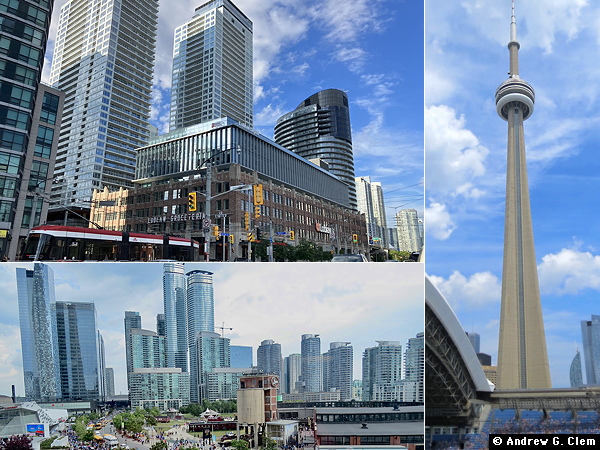
CLOCKWISE FROM TOP LEFT: High-rises near Lakeshore Drive, on the west side of downtown; the iconic CN Tower; and distant high-rises east of downtown, with Roundhouse Park in the foreground.