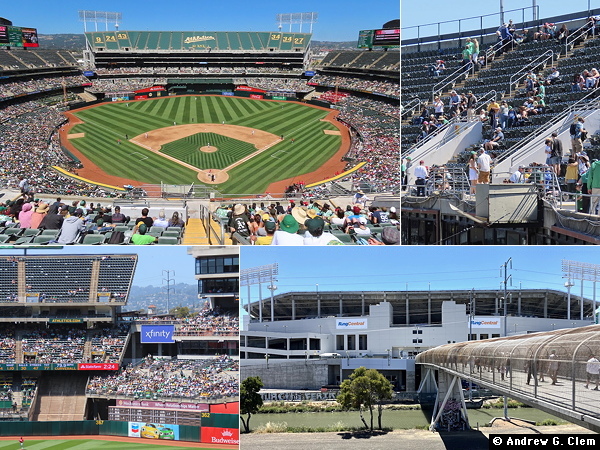
Photos below!
ALL STAR GAME: 1987 WORLD SERIES: 1972, 1973, 1974, 1988, 1989, 1990 (4 wins, 2 losses)
Origins and design
With a circular design that was clearly intended for baseball use just as much as for football use, this could be considered as an "on-speculation" stadium, i.e., one that was built with public funds for the express purpose of luring a baseball franchise to relocate from another city. With all of the seats being aligned in one big circle and oriented concentrically, the design resembled Atlanta-Fulton County Stadium, with huge foul territory that favored pitchers and penalized fans by making them sit far from the action. The obvious difference from Atlanta Stadium was that the upper two decks only extended for about 255 degrees (71 percent) around the circle; this was the same setup as at Shea Stadium and (until 1989) the Astrodome.
The seating reconfiguration at Oakland Coliseum scheme was unique. There were only small movable sections that filled either the "notch" behind home plate and at the foul poles (for baseball games), or the "notches" at the corners of the end zones (for football games). When the A's first played there (in 1968), the backstop distance was about 74 feet. (I disagree with other sources that indicate it was 90 feet.) This was reduced to 60 feet after the first year, as the fences in center field and the power alleys were brought in about ten feet as well, widening the gap between the fence and the bleachers. Most of the bleachers were movable, for use during football games. Fans using those bleachers entered via the wide concrete stairs at either end of the lower deck, an odd anomaly. To get to the upper deck, fans use stairways from the rear of the second deck to the front edge of the upper deck, passing in between the (rather cramped) luxury suites. Another odd feature of the Coliseum was that players accessed the dugouts via ground-level passages along the "cutouts" behind home plate, rather than via a tunnel as is the case in most stadiums. Several years later, scoreboards were added under the light standards; the 1969 diagram above reflects this minor change. The outfield fence was apparently moved in a few feet in 1981, and then moved back in 1990.
Although Oakland Coliseum is triple decked, the upper deck is smaller than the ones in most other stadiums. The stadium was built along the insides of a massive excavated "doughnut," and the playing field is actually below sea level. In its natural state, prior to reclamation, this industrialized area south of Oakland had once been a flat seaside marsh. The upper concourse behind the middle deck is at the top of that excavated "doughnut," while the lower concourse in back of the first deck is below ground, much like how Dodger Stadium was built into the side of a huge ravine slope. Oakland Coliseum is conveniently located with a train station across a pedestrian bridge beyond center field, and a rapid transit (BART) station just a bit farther. It stood out in being one of the few baseball stadium to lack any roof; the only other such stadiums during the 1970s were Memorial Stadium (in Baltimore), Metropolitan Stadium (in Minnesota), San Diego (later Jack Murphy) Stadium, and Jarry Park in Montreal.
 The Athletics had been a mediocre team for several decades, in both Philadelphia (at Shibe Park / Connie Mack Stadium) and Kansas City (at Municipal Stadium), but they finally "struck gold" after moving to California, at least in terms of success on the field. Indeed, the A's became one of the dominant teams in baseball in the early 1970s, winning consecutive World Series in 1972, 1973, and 1974. They had trouble drawing fans, however, and only in one of those years (1973) did total attendance exceed one million. Years before he became known as "Mr. October" while wearing Yankee pinstripes, Reggie Jackson proudly wore the yellow and green uniform as the Oakland A's number one star. In his peak-performing year of 1973 he was the American League champion in both the home run and RBI categories, two thirds of the Triple Crown. The new era of free agency ruined franchise owner Charley Finley's hopes of making a profit in a small-market city, and he just cashed in his chips. After Reggie left town in 1976, the A's became cellar-dwellers again, and attendance plummeted drastically.
Under new ownership during the 1980s the A's underwent a resurgence in fan popularity, and they even won the American League pennant three more times: in 1988, 1989, and 1990. The 1989 episode was made famous by the major earthquake that shook the whole Bay Area just before Game 3 of the World Series, played in Candlestick Park. After the series resumed, Oakland ultimately prevailed over the Giants and became world champions for the first time in 15 years. This was the era of sluggers Jose Canseco and Mark McGwire, the "Bash Brothers."
Football use
CINEMA: Oakland Coliseum was featured in the movie Moneyball (2011) starring Brad Pitt, and "played the part" of Anaheim Stadium in the movie Angels in the Outfield (1994), starring Danny Glover, Tony Danza, and Christopher Lloyd. [[[Jerry Maguire??]]]
Oakland Coliseum was home to the Oakland Raiders football team before the A's even came to town, but in 1982 the Raiders moved to Los Angeles, and for the next 15 years the A's had the house all to themselves. In the same year as the Rams moved out of Los Angeles in 1995, the Raiders did likewise and returned to their previous home in Oakland, after working out a deal to get funding for an expanded stadium. The center field bleachers were demolished in 1995, temporarily reducing the baseball capacity from about 48,000 to about 42,000, and construction on "Mount Davis" began in November. Because of construction delays, the Athletics had to play their first six games of 1996 in Cashman Field, in Las Vegas, Nevada. The capacity for football games is now about 63,000, compared to about 54,500 during the "original" (1966-1981) era. One notable feature of the Coliseum is that the football gridiron could either be laid out sideways (from left field to right field) or "vertically," from home plate to center field. (Note the "alternate" diagram version above.) The latter option was often used for practice games during August, to avoid going to the trouble of pulling out the expandable seating sections. After "Mount Davis" was built following the Raiders' return to Oakland in 1995, however, that alternative arrangement was not used.
As for the A's, however, the 1996 expansion significantly degraded the baseball experience. It replaced the nice wide-open view of a grassy slope and trees beyond the outfield bleachers with an intimidating and claustrophobic ambience, as the field is now dominated by thousands of empty seats in plain view in center field. On the plus side, the outfield fence did acquire some interesting angles with a high (15-foot) section in the power alleys where the out-of-town scoreboards are. The 362-foot distance to right center field "power alley" is shortest of all current Major League stadiums, by the way, while two stadiums -- Dolphin (Hard Rock) Stadium and Daikin (Minute Maid) Park -- have virtually the same distance to the left center field power alley. The new upper-deck outfield seats added for the Raiders in 1996 are not normally sold for baseball games and are thus excluded from the "normal" capacity figure, but they were made available for postseason games when attendance surged, with a maximum of 55,000 seats for baseball. New upper-level concourses and exit ramps were part of the 1996 expansion, and fans were able to enter the upper deck along a level surface rather than the stairways. (Those stairways remain intact behind the sections of the upper deck near the respective foul poles.) Finally, two rows of box seats were added behind home plate and between each dugout and respective bullpen. Foul territory remained enormous, nevertheless.
During the 2010s, the Oakland/L.A./Oakland Raiders lobbied to get a replacement for their aging stadium -- notwithstanding the relatively recent expansion of 1996, but in contrast to the the San Francisco/San Jose 49ers across the Bay, these efforts failed. On March 27, 2017, the National Football League finally announced that the Raiders would move to Las Vegas as soon as a new stadium was completed there. After a year's delay in construction, this finally came to pass in 2020 -- the year of the covid pandemic. This negated the possibility that Oakland Coliseum might be upgraded and made into a football-only venue, as I had proposed.
Name changes; new stadium talks
In late 1997 this facility was renamed "UMAX Coliseum," but a legal dispute annulled the naming rights contract only a few months later. Beginning in 1998 it was formally known as "Network Associates Coliseum," and in late 2004 it was changed again to "McAfee Coliseum," reflecting the change in the corporate name of that software maker. The five-year naming rights contract with McAfee expired in September 2008, and for a while, the original name was back in use. To cap the absurdity, in March 2011 it was renamed "Overstock.com Coliseum," or just "O.co Coliseum" for short. After further legal disputes erupted, the original name "Oakland Coliseum" was restored in 2016, until another naming rights deal was signed in 2019, but that change was put on hold pending legal disputes, and the new name "RingCentral Coliseum" finally became "official" in 2020 -- when no fans were allowed to attend due to the coronavirus. (See the Stadium names chronology page.)
Prior to the 2006 season, the A's announced that the entire upper deck of the Coliseum would be closed for the 2006 season, covered with a huge olive green tarp that shows yellow Athletics logos. This modification artificially reduced its capacity for baseball games from about 44,000 to about 34,000. Those tarps were removed in mid-April 2017, raising the capacity of the Coliseum by 12,103 seats. Prior to the 2019 season, a section of lower deck seats near the right field foul pole was replaced with tables, becoming the family-friendly "A's Stomping Ground." (It is now sponsored by Budweiser, presumably not so "family-friendly.") A year later something similar was done in the corresponding area near the left field corner, now called "Oak Landing."
After John Fisher acquired a majority share of the Athletics franchise in 2005, hoping to restore his team to its former glory, he delegated to minority owner Lew Wolff the task of getting a new stadium deal elsewhere in the Bay Area, presummably where the demographics are more "upscale." In November 2006, he reached a tentative agreement with the city of Fremont, but the "Cisco Field" proposal encountered repeated obstacles and died in early 2009. After that, they began negotiating with the city of San Jose, even farther to the south, but the the territorial rights of the neighboring San Francisco Giants rendered that option virtually null. Hopes rose in 2018, with discussions about a new baseball stadium along the waterfront near downtown Oakland, but nothing came from these talks. Early in 2023 it was learned that the Athletics acquired land in Las Vegas for the purpose of building a new baseball stadium, and after the lease on the Coliseum ended after the 2024 season, the Athletics relocated to Sacramento (Sutter Health Park), pending completion of their future stadium under construction in Las Vegas. It's a real tragedy. After more than a half century in Oakland, the Athletics moved for a third (and soon fourth) time.
SOURCES: Lowry (2006), Pastier (2007), USA Today / Fodor's (1996), Rosen (2001)
WEB LINKS: maps.google.com, stadiumsofnfl.com
Ratings and geography
| The Clem Criteria: | |||||
|---|---|---|---|---|---|
| Field asymmetry |
Archi- tectural design |
Seat proximity |
Location * | Aesthetics | Overall |
| 4 (+) | 5 | 3 | 4 | 4 (-) | 4.0 |
* See the Stadium locations page.
The asymmetry factor increased after 1996, while the aesthetics declined.

Visit the San Francisco Bay Area!
San Francisco gets all the attention, tourism-wise, but there is plenty to see on the east side of the Bay. While Oakland has more than its share of social problems associated with poverty, and the skyline is dominated by massive cranes along the cargo loading docks, there are many pleasant views as well. Lake Merritt, a popular location for recreation and nature, is located only a few blocks from downtown. East of the city are the Oakland Hills, a mountain ridge that culminates in Mount Diablo to the northeast. The University of California campus in Berkeley (a few miles north) features beautiful buildings and spectacular scenic views, as well as immense redwood trees. Getting around is easy via the Bay Area Rapid Transit (BART) system, with connections to San Francisco (west) as well as San Jose (south).
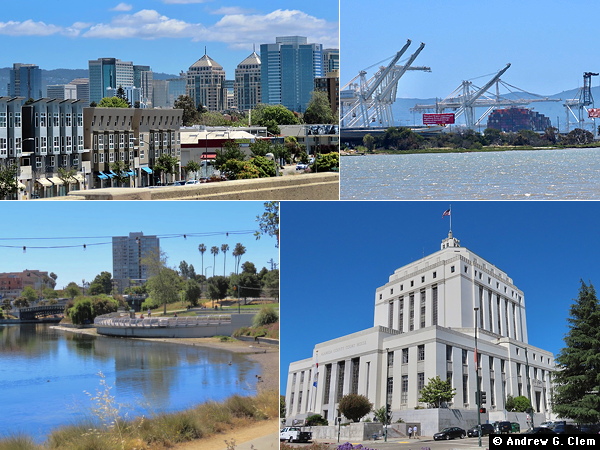
CLOCKWISE FROM TOP LEFT: Alameda County Courthouse; Lake Merritt (which is actually an ocean inlet); the downtown Oakland skyline; and the clocktower atop the old Oakland Tribune building.