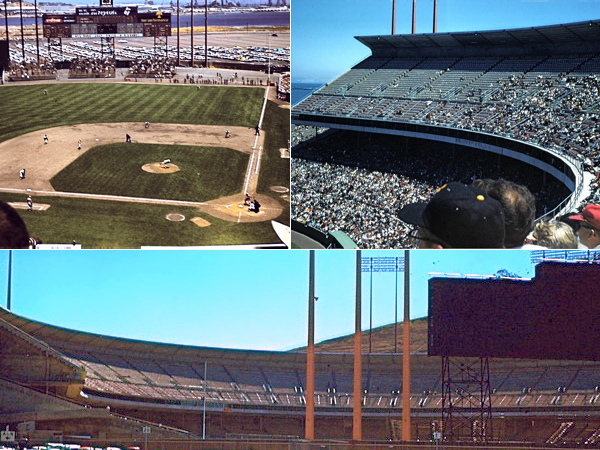
Photos below!
ALL STAR GAMES: 1961, 1984 ARTIFICIAL TURF: 1971 - 1978
WORLD SERIES: 1962, 1989 (0 W, 2 L)
Candlestick Park had its origins in the shady dealings that induced the New York Giants to move to the West Coast in 1958. A cunning developer named Charles Harney got the mayor of San Francisco to offer the Giants a large plot of rocky land on the San Francisco Bay for a new stadium with plenty of parking space, but he failed to inform the mayor or the Giants' officials of the fierce winds and chilly night temperatures that plague that area. The new stadium took only two years to build, during which time the Giants played in Seals Stadium. Meanwhile, the newly relocated Brooklyn-to-L.A. Dodgers had to wait an additional two years for Dodger Stadium to be finished. Candlestick Park in many ways fit the standard of a modern baseball stadium, with a symmetrical structure and field layout, an acute-angle grandstand configuration, and a small "roofette" that was years ahead of its time. "The 'Stick" was the very last major league baseball stadium with supporting columns: almost half of the lower deck was "in the shade," and a substantial number of seats had obstructed views. Another quite singular aspect was that it originally had two levels of entry portals in the upper deck, just like Shibe Park and Veterans Stadium. With 30 rows of seats in the upper deck (eight below the lateral walkway), the extra access made sense.
In terms of design, Candlestick Park stood out in two ways: The curvature of the grandstand arc behind home plate was extremely broad, almost as big as the Giants' old home in the Polo Grounds, in fact. Second, the first deck extended way out beyond the left field fence and made a broad arc toward center field. This design resembled a football oval and was probably intended to lure the San Francisco 49ers to play there, but that didn't happen until 11 years after it opened. (Note, however, that the "Oakland" Raiders did make Candlestick Park their temporary home during the latter part of 1960 and all of the 1961 season.) The stadium design was certainly ill-suited to baseball fans, who had to sit far away from the action.
 Candlestick Park became the object of ridicule and scorn after the horrendous winds blew Giants' pitcher Stu Miller off the mound during the 1961 All-Star Game. (Some people dispute that story.) In part because the windy conditions were not amenable to home runs, the outfield fence was moved inward one year after this stadium opened, reducing the distance in the power alleys by 20-30 feet. Even so, this ballpark remained very unfavorable to batters, and probably reduced the lifetime home run record of Giants' slugger Willie Mays by at least a hundred. (At 660, he fell short of both Babe Ruth's 714 and Hank Aaron's 755 totals.) Because of the chilly, windy evenings at Candlestick, the Giants played most of their games during the day, even as most other teams shifted to mostly-night schedules during the 1970s.
During 1971 Candlestick Park was under construction to make room for the San Francisco 49ers, who finally decided to leave Kezar Stadium. The second deck was extended all the way around the outfield, with the front edge hanging right in back of the right field fence. Underneath it on the right field side was a large retractable grandstand section that, when pushed forward for football games, met flush with the upper deck to create one enormous deck on the north side of the field. (This innovative "massive retractable" seating system was later adopted at the Metrodome and Dolphin Stadium, and was also imitated on a smaller scale at several other stadiums.) Also, a new press box was built at the top of the second deck along the left side. As a result of the expansion, the seating capacity for baseball games rose from about 43,000 to 58,000. Candlestick Park assumed a sort of rounded triangular shape, somewhat like Yankee Stadium, only "fatter." Even though it was fully enclosed after 1971, the stadium remained plagued by unpredictable high winds. Artificial turf was installed in 1970, making it easier for the subsequent baseball-to-football conversion, but the decision was reversed in 1979 when they put real grass back in, leading the way in baseall's "back to nature" movement.
CINEMA: Candlestick Park was featured in the movie The Fan (1996), starring Robert DeNiro and Wesley Snipes; and had a cameo appearance in Experiment In Terror (1962).
Hindsight is 20-20, but San Francisco certainly could have come up with a better compromise between the needs of football and baseball when they expanded Candlestick Park in 1972. That is why I have added three imaginary diagrams above, in which a new fully-movable grandstand would have been built in right field. That is the system which was adopted in Denver for Mile High Stadium just a few years later. In the football configuration, Alternate Candlestick Park would have been a nearly complete oval, with most seats in close proximity to the field, but with a smaller seating capacity -- probably about 62,000 seats, rather than 70,000. Many of the seats in that movable grandstand would have been too far from the field to see much action at baseball games, so the effective capacity for the Giants would have been about 55,000.
For many years the Giants languished in obscurity, but in 1989 they made it to the World Series for only the second time since moving to California, going against the Oakland Athletics, just across the Bay. It was the first World Series between two teams from the same metropolitan area since 1956, when the Yankees played against the Brooklyn Dodgers. The Bay Area Series was rudely interrupted by a serious earthquake, as several large chunks of concrete fell but somehow managed to miss any of the spectators.
The passage of time did little to ameliorate the woes of this misbegotten stadium. At some point, perhaps in the 1980s, it was decided that more seats were needed, so they added three rows of seats covering the lower set of entry portals in the upper deck. In 1993 temporary bleachers were installed in back of the left field fence to bring the fans a little closer to the action. That was the same year the Giants acquired MVP Barry Bonds from the Pittsburgh Pirates, but it wasn't until 1997 that they managed to win another divisional title. Being close to Silicon Valley, it was probably inevitable that San Francisco would succumb to the Great High-Tech Corporate Name Sell-out of the 1990s. The computer networking company 3-Com won the bidding and got their name tacked onto the place in 1995. (See the Stadium names chronology page.)
During the 1990s the Giants put together a creative deal that led to the construction of their beautiful new home at Pac Bell Park (later SBC Park, then AT&T Park, and now Oracle Park), on the south side of downtown Frisco. They said goodbye and good riddance to Candlestick Park at the end of the 1999 season. In spite of their spectacular success, winning five Super Bowls in the 1980s and 1990s, the 49ers had a hard time mustering community support to build a new stadium to replace their creaky old stadium. In 2011, however, they finally reached a tentative agreement to build a new stadium in Santa Clara, which is near San Jose -- 30 miles to the southeast! After seats and other items of value were removed, full-scale demolition began in March 2015 and was completed in July. A mixed-use commercial development now occupies that site.
The Beatles' last public concert took place in Candlestick Park, on August 29, 1966. One year later came the "Summer of Love."
SOURCES: Lowry (2006), Pastier (2007), Gershman (1993), USA Today / Fodor's (1996)
| The Clem Criteria: | |||||
|---|---|---|---|---|---|
| Field asymmetry |
Archi- tectural design |
Seat proximity |
Location * | Aesthetics | Overall |
| 3 | 5 | 2 | 4 | 4 | 3.6 |
* See the Stadium locations page.