


 Photo!
WORLD SERIES: 1997, 2003 (2 wins, 0 losses)SUPER BOWLS: 1989, 1995, 1999, 2007, 2010 ORANGE BOWLS: 1996 - present
Joe Robbie Stadium (as this venue was originally called) was designed exclusively for football, but the possibility of using it for baseball games was incorporated into its design. For that reason, it seemed like a dubious home for a baseball team when MLB awarded Miami one of the expansion franchises for the 1993 season. (Ironically, there was already a baseball stadium ready and waiting for a new or relocated MLB franchise farther north in St. Petersburg, Florida: what is now called Tropicana Field! It had to wait five more years.) Actually, however, the Orioles and Dodgers had already played a preseason exhibition game here on March 11, 1988. Joe Robbie, who earned his law degree from the University of South Dakota, was the original owner of the Miami Dolphins when the franchise was created in 1966. After two decades in the Orange Bowl, he built the stadium that bore his name, or used to, without the use of any public money. The design was virtually identical to an early proposal (1965) for Veterans Stadium in Philadelphia, and its oblong octagonal shape also resembled the Pontiac Silverdome and the Alamodome in San Antonio.
In 1990 Wayne Huizenga bought half of Joe Robbie Stadium to pave the way for his acquisition of a new major league baseball franchise; in 1994 he bought the remaining 50 percent share. In preparation for arrival of the Marlins, most of the lower deck on the north side was torn out and replaced with a new retractable seating section. The results of the permanent reconfiguration for baseball weren't as bad as one might think, especially with that distant nook just left of center field. (NOTE: I learned from a fan that the 1990 configuration with seats added along the foul lines as shown in the diagram above (previously labelled "1993") was never used for Marlins games; it is based on a photo in Gershmans' book Diamonds, evidently from a pre-1993 exhibition game.) It is interesting that both expansion teams in 1993 made their home in oversized football stadiums, the other being Mile High Stadium.
In hopes of making the otherwise plain venue more fan-friendly, the Marlins added a terraced picnic pavilion area in the right center field, and later moved it to the right field corner. The seating areas in the left field, center field, and right field portions of the upper deck, and in the center field portion of the lower deck are normally used only for football games. In both the 1997 and 2003 World Series, however, the Marlins did use these sections, and over 65,000 fans attended in all seven of those games. (The biggest crowd was at Game 6 of the 1997 World Series: 67,498.) With no roof, it is usually much too hot to enjoy an afternoon game in the Miami summer, and it became increasingly obvious that this would never be suitable as a baseball stadium. After winning the 1997 World Series, Huizenga tried to get public funding for a new baseball-only stadium, but failed to persuade legislators. In frustration, he decided to cash in his chips and liquidate his highly-paid talent after, and finally sold the franchise to John Henry. The Marlins went down hill fast, and the crowds grew thinner and thinner. It gets pretty lonely staring at 50,000+ empty seats, game after game.
 Under the original plan for the baseball configuration, the outfield dimensions were to be rather symmetrical, with no unusual features. But when the Marlins began playing in 1993, they spiced things up with a large 33-foot high scoreboard in left field, known the "Teal Monster," an imitation of Fenway Park. Also, an irregular nook was added left of center field, like the one to the right of center field in Boston. I estimate the distance to the deepest corner as about 420 feet; unfortunately, the mistaken "434" marker in that spot remained in place until the end of the baseball era. There is no marked distance to straightaway center field, which is only about 400 feet. I estimate that the corner to the right of the "404" marker in center field is about 410 feet from home plate. Prior to the 2004 season, the distance marker in left center field was changed from "361" to "360," and the marker in right center field was changed from "385" to "363" and moved about 30 feet toward the right. For some reason, the latter marker was changed back to "385" in 2006, but was left it in the same place, which is clearly mistaken. The distances to the foul poles were off by a couple feet as well, according to Professor Brian Raue at Florida International University. As indicated in the "Vital statistics" table above, I concur with his measurements of 327.5 to left and 347.25 to right.
CINEMA: Dolphin Stadium was featured in the motion picture Ace Ventura: Pet Detective starring Jim Carey.
Just before the 2002 season began, former Montreal Expos owner Jeffrey Loria bought the Marlins in a complicated three-way deal under which John Henry bought the Boston Red Sox. Loria's former team, the Expos, was purchased by MLB and slated for "contraction," along with one other team -- the Twins, most likely. Because of the lack of a decent stadium, the Marlins themselves were mentioned as a possible candidate for elimination. One year later, however, the Marlins won the wild card race and then managed to defeat the Giants, the Cubs, and then the Yankees to become World Series champions for a second time. After this remarkable triumph, there was rising optimism about reaching a stadium financing agreement so that the Marlins could finally have a home of their own. It took several more years of political wrangling before this came to fruition, however.
The many name changes of this stadium (also see the Stadium names chronology page) are a story in itself, summarized in this table:
| From | Until | Stadium name | Years with Marlins | Notes |
|---|---|---|---|---|
| 1987 | 1996 | Joe Robbie Stadium | 4 | Named after Dolphins' owner. |
| 1996 | 2004 | Pro Player Stadium | 9 | Contract was in limbo after parent company Fruit of the Loom went bankrupt in 1999. |
| 2005 | 2008 | Dolphin Stadium | 4 | Named for the NFL team. (Briefly it was plural: "Dolphins Stadium.") |
| 2009 | 2009 | Landshark Stadium | 1 | One-year contract with Jimmy Buffet's beer company. |
| 2010 | 2016 | Sun Life Stadium | 2 | Five-year contract with Canadian financial services company. |
| 2016 | present | Hard Rock Stadium | 0 | Contract with restaurant/bar chain. |
During 2005, the massive renovation program slowly got underway. The first phase primarily involved building a new concourse and lounge areas around the periphery of the stadium, and it was completed in 2007. Over the long-term future, the Dolphins are considering a roof, either fixed or retractable. The Dolphins informed the Marlins that they would not offer a lease renewal, which could theoretically leave them "homeless." State and local governments were reluctant to contribute enough money for a new ballpark, however. From late 2005 through early 2007 representatives of the Marlins visited Portland and other cities in search of a new home, without success. During the summer of 2008, as the Orange Bowl was demolished, hopes rose that a new stadium would be built in that plot of land near downtown Miami. (The annual Orange Bowl game has been played in what is now called Hard Rock Stadium ever since 1996.) Finally, in March 2009, funding for a new Marlins baseball stadium was approved by the Miami-Dade County commissioners, and construction of a retractable-roof facility began in July. During construction, as part of a bid to draw a wider fan base, the Marlins "hosted" a three-game series against the New York Mets in June 2010 at Hiram Bithorn Stadium in San Juan, Puerto Rico. Work on the new stadium was largely completed by the summer of 2011, and on September 28, 2011 the Marlins lost their final game in their original home to the Washington Nationals, 3-1. The gleaming new Marlins Park (now called "Loan Depot Park") formally opened for business in April 2012, as the Florida Marlins became the Miami Marlins.
Prior to the 2015 football season, Sun Life Stadium was thoroughly rebuilt as part of a $425 million renovation project, with about six new rows of seats added along the sides, at a shallower gradient ("pitch") than before. In addition, many seats from the corner sections of the upper and lower decks were removed, creating room for new party terraces. By the 2016 season a giant roof covered the entire grandstand (but not the field), held up by cables attached to a tower at each of the four corners. In the process, a large number of diagonally-oriented seats were removed, and the original inward-angled light towers were replaced by lights along the interior of the roof.
SOURCES: Lowry (2019); Pastier (2007); Gershman (1993); USA Today / Fodor's (1996); Rosen (2001); Brian Raue (2001); MLB.com; about.com, temple.edu; digitalballparks.com, baseball-reference.com
FAN TIPS: Mike Feldbush, Mike Hofer, Marc Gilbert
| The Clem Criteria: | |||||
|---|---|---|---|---|---|
| Field asymmetry |
Architectural design |
Seat proximity |
Location * | Aesthetics | Overall |
| 5 | 5 | 3 | 1 | 2 | 3.2 |
* See the Stadium locations page.

Visit Miami!
For those going to see Miami Dolphins games or University of Miami Hurricanes games, what is now called "Hard Rock Stadium" is located about 14 miles north of downtown Miami. In the fall, winter, and spring, Miami is a wonderful, warm refuge from the freezing climes of the north, with endless opportunities for fishing, boating, and other outdoor recreational activities. Those interested in nature excursions can see plenty of exotic birds, alligators, and tropical plants in the nearby Everglades.
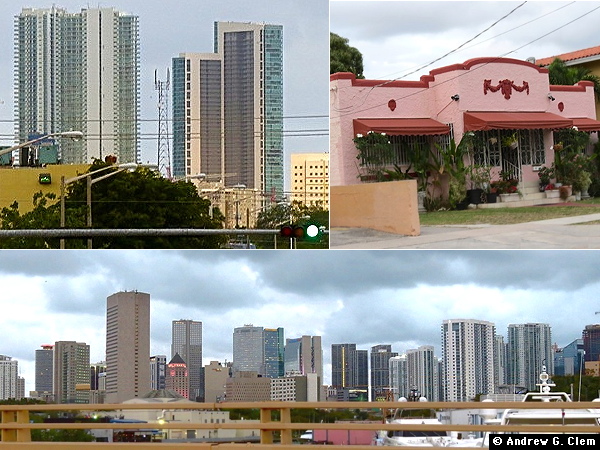
The city of Miami abounds with high-rise condos full of retirees from the north, as well as remnants of the Art Deco style that predominated in the mid-20th Century.
