


 Photos below!
ALL-STAR GAME: 2018 WORLD SERIES: 2019 (1 win, 0 losses)
BEEN THERE, DONE THAT: Three times during construction (2006-2008), and a total of 35 games (plus a few non-game visits) from 2008 to 2022.
There was one non-negotiable condition under which Major League Baseball would approve the relocation of the Montreal Expos to Washington D.C.: the city government had to agree to fully fund a new stadium with all the modern amenities and at least 40,000 seats. After a series of bizarre political maneuverings between the Mayor's office and the D.C. Council, final approval of a revised deal was reached at the last minute in March 2005, mere weeks before the new Washington Nationals team was scheduled to begin playing. Soon after the sale of the Nationals franchise was consummated, construction began in May 2006. Originally, it was expected that the naming rights would be sold to a corporate sponsor, but there were no satisfactory bids, so the stadium is known as "Nationals Park." Good!
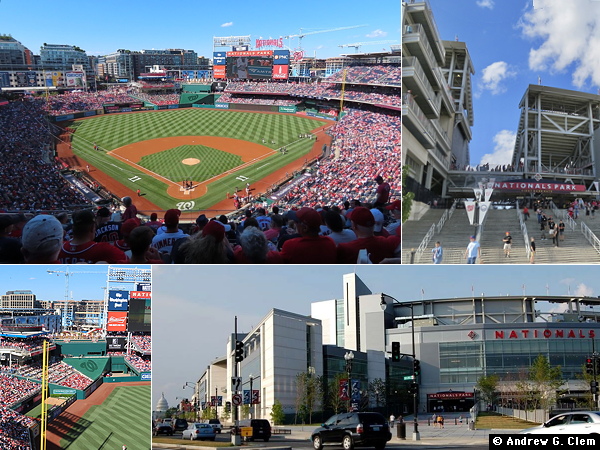
The stadium design takes a while to appreciate, as it does not fit the mold of "neoclassical" stadiums, and is thus better regarded as a "postmodern" stadium. The external appearance is quite striking, with large expanses of (simulated) granite walls reminding one of the office buildings on Capitol Hill. It is, after all, designed to look like it belongs in the Federal City. The huge panes of glass convey the sense of a high-tech corporate headquarters, of which there are many in the Washington area. My first impression was that it resembled Cincinnati's Great American Ballpark, but the design also includes a number of subtle aesthetic and geometric features. For one thing, each of the five principle corners in the outfield wall matches the distance to the outfield in RFK Stadium at that particular angle, though the intervening points are of course considerably shorter. The right and left ends of the upper deck are truncated by a straight line that extends toward the west-northwest, possibly aligned with the Washington Monument or the Lincoln Memorial. In addition, the entrance along South Capitol Street aligns with O Street Southwest. Much like at Progressive Field, the shape of the stadium and the field does conform to surrounding street grid, which lends the design a certain authenticity. The walls in the right field corner and left center field are parallel to First Street Southeast and N Street, and therefore perpendicular to each other. The angle of the wall on either side of center field remind one of "The Jake," as well as Wrigley Field (L.A.) and Memorial Stadium. The separate, lower-profile grandstand in the right field corner is much like Comerica Park and other recent ballparks.
 Approaching from the south, crossing the Frederick Douglass Bridge, visitors get a spectacular view of the stadium and the adjoining wedge-shaped office building. There is enough open land on the south side for grass and shrubbery, which adds immensely to the ambience. Before long there will be a dock at which boat passengers from Alexandria can debark and walk up to the huge staircase leading to the grandstand gap on the first base side. Heeding the concerns of neighborhood residents, there are only two light towers, one near the left field corner, and one atop the scoreboard in right center. Lights extend along the front edge of the roof, from end to end, like at (renovated) Yankee Stadium. The slight jut in the wall in left center accommodates the restaurant seating, a (pale) attempt to mimic the large jog in the center field of Griffith Stadium.
Much is said about all the wonderful amenities for fans and the variety of eating options, but accommodations for budget-minded fans are scant. A small section near the end of the upper deck has been be set aside for day-of-game cheap tickets, but there aren't any real bleachers at all. That is a big shame. If the Nationals front office really wants to make this team popular in the city, they ought to make the outfield seats near the visitors' bullpen a real bargain-bleacher section, for five bucks a pop, max. There are multiple elite seating sections behind home plate, and the box seats run as much as $325 a pop. On the left side of center field is the "Red Porch" section for restaurant patrons, part of which is an "all-you-can-eat" deal. Above that restaurant is a giant baseball, with upper-level seats. There are also elevated seats above the batter's eye in dead center field, behind which one can find amusements for kids of all ages. The batter's eye itself is a triangular-shaped slope on which a special dark blend of grass has been planted.
CINEMA: Nationals Park appeared in the movies How Do You Know (2010) and (as a distant glimpse at night) State of Play (2009).
From the players' perspective, the primary difference is that the power alleys are a lot easier to reach than in RFK Stadium, so there are likely to be many more home runs. The Nationals' bullpen is in the right field corner, where it was located during their latter two years in RFK Stadium. Likewise, it is mostly covered by the upper deck, providing much-needed shade on those hot D.C. afternoons. Players are pampered with an ample, luxurious clubhouse, with such high-tech training equipment as an underwater treadmill. It is shaped like an oval, like the office in the White House.
With construction continuing in the immediate vicinity, Nationals Park looks a little rough during its inaugural season, but by 2009 it will be further "polished." One of the nicest features is the row of cherry trees that have been planted in back of the left field seats. Also, statues of Josh Gibson, Frank Howard and Walter Johnson were built prior to the 2009 season, and a team museum full of old Senators memorabilia has opened. (Presumably there will be Expos memorabilia as well.)
Less than a block away on the south side (first base) is the Anacostia River. The playing field is about 15 feet below street level on that side, and as is the case at PNC Park in Pittsburgh, the proximity to a major river may create a problem with the water table, if not with actual flooding. The stadium will, in time, hasten the redevelopment of a old industrial neighborhood that used to be filled with motley warehouses, bars, row houses, repair shops, an artist studio, and a recycling center. Nearby are (or were) Metro bus yards, a cement plant, and the Good and Plenty carry-out / eatery. Too bad they couldn't have preserved some of those establishments for historical purposes. The Federal Center Southeast office building complex and the historic Navy Yards are situated on the east side.
As with Oracle Park, Chase Field, and a few other "neoclassical" or "postmodern" ballparks, Nationals Park seems to have been designed to allow football games to be played there. The D.C. government has explored the possibility of holding a collegiate bowl game within the district, rather than FedEx Field which is Landover, Maryland. After RFK Stadium is demolished (in 2023, perhaps?, Nationals Park might indeed take on an additional postseason role.
In their first regulation game in their new home, on March 30, 2008, the Nationals beat the Atlanta Braves by a score of 3-2, thanks to a dramatic and memorable walk-off home run by Ryan Zimmerman. On April 17, while the Nationals were out of town, Pope Benedict said mass before an estimated 46,000 faithful Catholics -- making this a true "Green Cathedral" in every sense of the word. He then left Washington to do the same in New York's Yankee Stadium. The Nationals finished their inaugural year in Nationals Park with a very disappointing 59-102 record, and did nearly as poorly in 2009, but have vastly improved since then. Boosted by the pitching of Stephen Strasburg and the slugging of Bryce Harper, the Nationals reached the postseason for the first time in 2012, with the highest winning percentage in the major leagues. The St. Louis Cardinals came from behind to win the deciding Game 5 of the National League Divisional Series, however, and in a similar fashion, the Nationals exited the postseason prematurely after winning the NL East Division title again in 2014, 2016, and 2017. Finally, in 2019, the Nats overcame a horrible early season (19-31 as of May 23) and, with a combination of aging veterans such as Ryan Zimmerman, Max Scherzer, and Howie Kendrick, midcareer superstars such as Anthony Rendon, and young stars such as Juan Soto, they actually won the World Series -- in spite of losing all three home games! It was the first time that had ever happened, and it was the first time since 1924 that the championship trophy had been brought home to Washington.
On January 1, 2015 Nationals Park hosted the National Hockey League "Winter Classic," as the Washington Capitals defeated the Chicago Black Hawks with a thrilling final-minute goal. Prior to the 2017 season, a row of below-ground seats was added to the right side of the dugout on the first base side. On July 17, 2018 the All Star Game was played in Nationals Park -- the first such event in Washington since 1969. The American League won, 8-6 in ten innings.
SOURCES: Lowry (2007), Washington Post, MLB.com
| The Clem Criteria: | |||||
|---|---|---|---|---|---|
| Field asymmetry |
Architectural design |
Seat proximity |
Location * | Aesthetics | Overall |
| 5 | 8 | 7 | 7 | 8 | 7.0 |
* See the Stadium locations page.

Visit Washington!
Every true American -- regardless of race, religion, or national origin -- should make a pilgrammage to his or her National Capital at least once in a lifetime. The Fourth of July celebrations can get crowded (and often hot), but there are plenty of attractions to see.
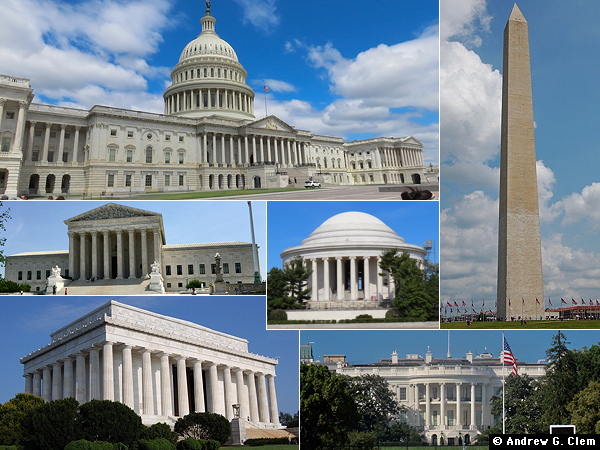
CLOCKWISE FROM TOP LEFT: U.S. Capitol (southeast); the Washington Monument; the White House; the Lincoln Memorial; the Supreme Court building; and (center) the Jefferson Memorial.
 Regular photos below
