

 Photos!
ALL-STAR GAME: 2015
BEEN THERE, DONE THAT: Aug. 2002 (u.c.), Aug. 15, 2004 (SD 7, CIN 2); Aug. 15, 2009; July 27, 2014 (WSH 4, CIN 2); nearby on Aug. 6, 2017
Contrary to what one might think, the name of the Reds' new stadium is not brazen boastfulness, but rather is the name of the insurance / financial services corporation that paid for the naming rights. "Great American"certainly is a beautiful ballpark in a picturesque setting, but it goes a bit overboard in terms of design features. It would seem that the architects were trying to overcompensate for all the flaws of its rather dull predecessor, Riverfront Stadium (a.k.a. Cinergy Field), which used to stand right next to where GABP (as it known for short) is located. (Hence the two-phase demolition.) Like a theme park, it has a big riverboat paddle wheel and two smokestacks beyond center field. Great American Ballpark is wide open, providing good views of the Ohio River (at least for upper-deck fans), whereas the old stadium was fully enclosed. Most notably, there is a gap between the upper decks on the left side behind home. (NOTE: The profiles in the diagram above apply to the respective side of the grandstand they are on.) Also, the upper deck is much smaller on the third base side, with virtually no overhang over the mezzanine deck, quite unlike the first base side. The forward portion of the grandstand roof consists of bare structural beams of uncertain purpose, similar to PETCO Park and Progressive Field.
 Just as Riverfront Stadium and Three Rivers Stadium shared many design features (and "birthyears"), GABP and Pittsburgh's PNC Park (two years older) bear many similarities. The most notable parallels are the outfield dimensions, the configuration of the seating areas, and the river beyond the right field seats. In back of the center field fence is a shrub-covered slope and the "Batter's Eye Pavilion," a lounge with dark windows. In addition, there is a distinct bend in the fence in dead center field, which was presaged by the similar "bent" fence in "Cinergy Field" during its last two years when the outfield grandstand was demolished to make room for construction on GABP. Foul territory is miniscule, though the curvature of the grandstand in that area is broader than at PNC Park. (much like Citi Field) The correspondingly-positioned scoreboard in left field is the longest one in all of major league baseball, and the upper deck below it consists of true bench-style bleachers. Behind that scoreboard is a huge image of the bat and ball with which Pete "You Bet!" Rose hit his 4,192nd hit, breaking Ty Cobb's record. Between GABP and U.S. Bank Arena on the east side is "Pete Rose Way," part of which is visible in one of the photos below.
There are a number of oddities that make this venue quite unique, and perhaps a little strange. Both the grandstand on the first base side and the right field quasi-bleachers are gently curved, unlike any other neoclassical stadium. Those bleachers are much steeper than normal, and the number of rows declines steadily as it extends toward center field. This curvature of the outside perimeter of the stadium was forced by the curved street alongside the Ohio River. Apparently no one has yet hit a home run into the Ohio River on the fly, though in 2004 Adam Dunn hit one that bounced in. The upper deck on the first base side has a wide concourse that cuts into the profile of the deck, almost dividing it into two. At the far end of the mezzanine level near the right field foul pole is "Riverfront Club" upscale restaurant and a party deck. The very long stretches where the grandstand parallels the foul lines on both sides, especially the third base side, are much like Rangers Ballpark in Arlington.
Many aspects of GABP have obvious commercial origins, which is understandable given the limited public funding available in a smaller city. There are special party suites on both ends of the mezzanine level. In back of the grandstand behind home plate there is an office building complex that creates a triangular semi-closed plaza, somewhat like behind center field at Turner Field. (The building on the north side is visible in the diagram, but the building on the west side is not.) As you enter that plaza, there is a huge bas relief mural titled "The Spirit of Baseball." Quite appropriate for the home city of the very first professional baseball team. GABP has an excellent location, and recent sidewalk improvements have reduced pedestrians' isolation from the rest of downtown caused by the freeway. Ironically, on top of one of the tallest buildings are the words "PNC Bank," the namesake of the Pittsburgh Pirates' home.
Very few modifications to Great American Ballpark have been made since it was completed in 2003. The "Pilot House" above the building in center field was added a few years later, as was a small table seating area above the bullpen in the right field corner. Prior to the 2018 season, an elevated party deck (the "Budweiser Bow Tie" section) was built in that area, physically connecting the right field "bleachers" to the grandstand, although there is apparently no access for wandering fans.
With its cozy dimensions, the Reds' new home gained a reputation for being slugger friendly, though the inaugural year of Great American Ballpark was a disappointment as far as the home team's win-loss record. With the subsequent departure of the aging slugger Ken Griffey Jr. and young slugger Adam Dunn, the Reds were sorely lacking in offensive power. But then came Joey Votto, a leading contender for the 2010 National League MVP award. The Reds surprised nearly everyone and won the NL Central Division that year, and in 2012 as well. The subsequent loss of young ace pitchers Aroldis Chapman and Johnny Cueto were a big blow, but to their immense credit, the Reds have kept superstar Joey Votto on their payroll. Cincinnati baseball fans have reason to hope that the glory days of the "Big Red Machine" may come back once again.
SOURCES: Lowry (2006), Pastier (2007), Google Earth, www.blueskyaerialphotography.com
| The Clem Criteria: | |||||
|---|---|---|---|---|---|
| Field asymmetry |
Archi- tectural design |
Seat proximity |
Location * | Aesthetics | Overall |
| 5 | 7 | 7 | 7 | 6 | 6.4 |
* See the Stadium locations page.

Visit Cincinnati!
Like its sister city upstream on the Ohio River (Pittsburgh), Cincinnati has overcome its old reputation as a mere center of industry. As the birthplace of Doris Day (born Doris Kappelhoff), Cincinnati is proud of its strong German cultural heritage. Likewise, its location in a valley surrounded by big hills provides ample opportunities for nature viewing.
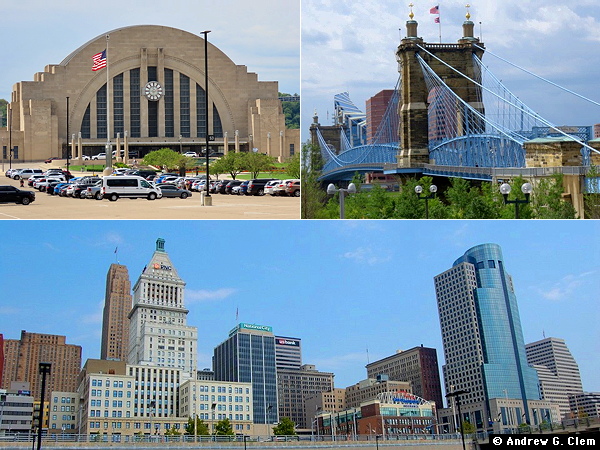
Cincinnati's Union Station, renovated a few years ago; the John Roebling bridge to Covington, Kentucky; and the skyline of downtown from the south.
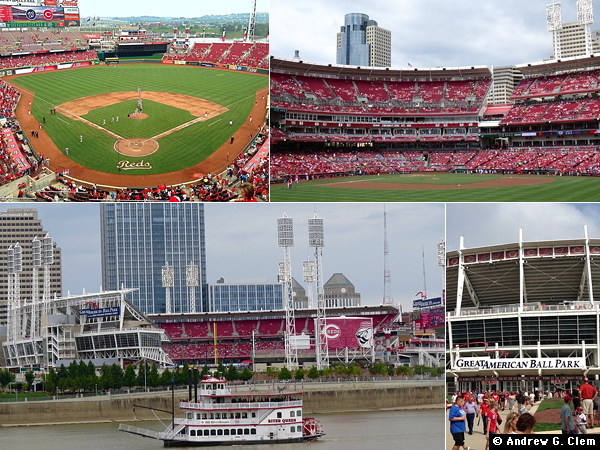
 below to display

