Photos below!
ALL-STAR GAME: 2000 WORLD SERIES: 1999 (0 W, 1 L) OLYMPIC GAMES: 1996
BEEN THERE, DONE THAT: Jacqueline and I saw a Cubs-Braves game on September 2, 2001.
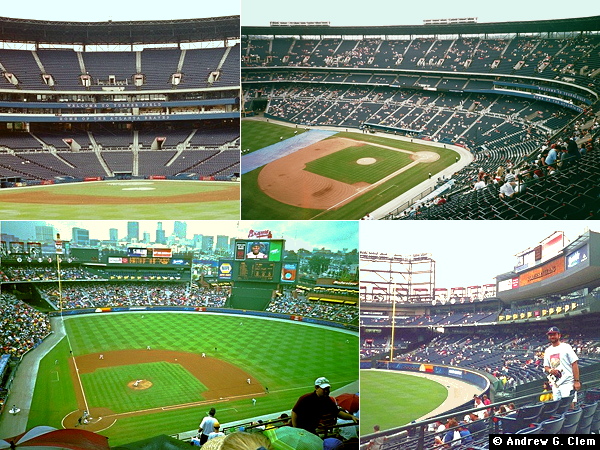
Turner Field is unique in having been built originally for non-baseball purposes (in this case, the 1996 Summer Olympic Games) and yet later became a first-class baseball stadium. Of course, it was planned that way from the beginning. Anyone who was watching the 1996 Olympics could note that one corner of the stadium (where home plate is now) was more sharply angled and further from the track than the others. About 30,000 seats were removed after the Olympics were over, and the bleacher sections and peripheral buildings in the plaza area were built in time for the 1997 baseball season. Twenty-two concrete pillars that used to support the perimeter of the single-deck grandstand beyond present-day left field remain in place, arranged in a vast semi-circle as a relic of the 1996 Olympics. They mark the extent of the original stadium "footprint," dividing the entry plaza from the curved street. (Hence the outline of the original stadium in the full-size diagram above.)
The playing field is about 25 feet below ground level, like most other newer ballparks. As for the field dimensions, Turner Field was rather ordinary, and in fact differed relatively little from its symmetrical circular predecessor, Atlanta-Fulton County Stadium. The right field fence angled away so that right center was one of the deepest in the major leagues, which is good for triples, but the rest of the fence is one big curve. In that respect, it is unique among the neoclassical "retro" ballparks. In terms of the grandstand configuration, the way the upper deck wraps around the right field corner bears some resemblance to Jacobs Field, now known as Progressive Field. The upper deck on the third base side is truncated, however, creating a more open "atmosphere" than most others in its class. There is a five-foot gap between the fence and the bleachers, to prevent fans from interfering with near-home runs, which takes away some of the fun. There was a plot of grass turf behind the center field fence; the grass grown there was used to repair damaged areas of the playing field.

From the fans' perspective, there were fewer luxury skyboxes than in most of the newer stadiums are found only in the left field second level, in back of the bleachers. The press boxes are in two levels that replace the mezzanine deck behind home plate; most newer stadiums have a similar press box configuration. Since Atlanta is the world headquarters for Coca Cola, there were large "Coke bottles" mounted like artillery guns in the kids play area on the narrow roof area overlooking the left field corner. There was also a large "Coke bottle" in that area that shoots huge Roman candle displays whenever the Braves hit a home run. The entrance plaza behind center field was full of Braves statues and memorabilia, with a wide array of amusements, shops, pubs, and eateries, mostly catering to the non-budget conscious. The "Braves Chophouse" overlooked right field, and the upscale "755 Club" restaurant overlooked left field. Those new fan amenities are typical of most new baseball stadiums. There are evidently few if any restaurants or watering holes in the surrounding neighborhood, however. Fans with slim wallets could take advantage of the cheap "Skyline" section at the far ends of the upper deck, on both the third base and right field sides.
Turner Field was one of the most successful neoclassical stadiums in terms of generating fan enthusiasm and attendance, though that slacked off a bit in the latter years. Like most other early-phase neoclassical stadiums, the capacity was a few thousand too high relative to the city's population. (It was reduced slightly from the original 50,091 to 49,586.) Prior to the 2005 season a newer, much bigger video board was installed. In 2008, a new section of seats (the "SunTrust Club") was installed between the dugouts, reducing the backstop distance to an absurdly close 43 feet. Behind the 143 new seats was an exclusive lounge full of posh amenities for fat cats in Atlanta.
CINEMA: Turner Field appeared in the movie Trouble With the Curve (2012).
The Braves continued their winning ways in the new stadium: They were champions of the National League Eastern Division in every year from 1995 through 2005. They had a hard time making it any farther in the playoffs, however. The departure or retirement of their phenomenal pitching trio (Greg Maddux, Tom Glavine, and John Smoltz) left the team without its formerly-dominant competitive edge. Even though aging slugger Chipper Jones retired after the 2012 season, the Braves surpised everyone by taking the NL Eastern Division by a wide margin in 2013. The rise of new stars such as catcher Brian McCann brought the Braves back to the upper tier of the standings during that decade.
To the surprise of many, the Braves failed to agree to terms with the city of Atlanta for funding desired renovations on Turner Field. Since the 20-year lease expired after the 2016 season, the Braves decided to build a new stadium in the northern suburbs of Atlanta. In September 2014, there was a groundbreaking ceremony for the future "home of the Braves," and in 2017 they moved into SunTrust Park, which was later renamed Truist Park. Turner Field lasted a mere 20 years as a Major League Baseball venue, barely half as long as the (Boston) Braves' tenure in Braves Field (1915-1952).
After the Braves left, in 2017 Turner Field was converted into a football stadium, as the new home of the Georgia State University Panthers, who did not even exist as a football team until 2010. That marked a second radical transformation of what was originally called "Olympic Stadium." At least it is getting more use than Globe Life Park (now known as "Choctaw Stadium"), which suffered a similar fate of being prematurely abandoned and seems to be in virtual "limbo." Both stadiums regularly host high school football games. After four years of being called "Georgia State Stadium," in 2021 it was renamed "Center Parc Stadium," under the terms of a contract with the Atlanta Postal Credit Union, which has the contractual option to rename the stadium again if it chooses.
SOURCES: Lowry (2006), Pastier (2007), USA Today / Fodor's (1996), Braves' FAN Magazine (2001); ballparkdigest.com
FAN TIP: Mike Zurawski
| The Clem Criteria: | |||||
|---|---|---|---|---|---|
| Field asymmetry |
Architectural design |
Seat proximity |
Location * | Aesthetics | Overall |
| 5 | 6 | 6 | 5 | 7 | 5.8 |
* See the Stadium locations page.

Visit Atlanta!
Just because the Braves got tired of playing near downtown Atlanta doesn't mean that you should avoid it. Rail travelers should be aware that the Amtrak station is on the north side of the city, so you'll need a taxi if you want to explore the state capitol, or the historic sites where Martin Luther King and other civil rights leaders once fought for social justice.
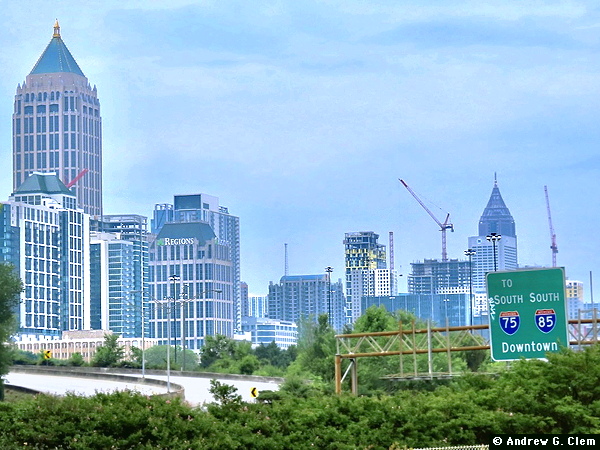
The north side of Atlanta, as seen from an Amtrak train. (June 11, 2023)