Top ~ General ~ International ~ National ~ State & local
Politics in general
"Politics must be understood through reason, yet it is not in reason that it finds its model. ... Politics is an art and not a science."
~ Hans Morgenthau
There are two main obstacles to objectively analyzing political decisions, behavior, and outcomes:
1) The values-laden subjective social milieu in which the observer finds himself or herself,
2) the essential self-reinforcing characteristic of most political phenomena, which gives rise to nonlinear, often-unpredictable outcomes.
Power
I would define politics as follows:
The pursuit of power in the public realm, the exercise of such power for particular or general purposes, and attempt to legitimize such power.
Interest
The Common Good Broad principles vs. particular interests: Agendas behind noble plans
Justice
Basic principle of politics
The things that one must do in order to get power (deal-making, disparaging opponents, etc.) often clash with considerations of the common good, which are supposed to influence public policy decisions.
Reality vs. utopia:
"Here, then, is the complexity, the fascination, and the tragedy of all political life. Politics are made up of two elements -- utopia and reality -- belonging to two different planes which can never meet."
~ E. H. Carr,
The Twenty Years' Crisis, 1919-1939 (1946)
E. H. Carr: "Here, then, is the complexity, the fascination, and the tragedy of all political life. Politics are made up of two elements -- utopia and reality -- belonging to two different planes which can never meet."
Paradox of collective action:
Security - power dilemma:
Diplomatic negotiations and two-stage game theory:
Liberal - Conservative Conundrum:
Following in the tradition of Charles Tilly, Bruce Porter provides considerable empirical and theoretical backing for the argument that war mobilization and the modern interventionist welfare state have been mutually reinforcing phenomena. As he writes,
Liberal and reform-minded political leaders abhor war, but recognize the opportunity it presents for social reform; conservatives revere military institutions and traditions, but are often wary of actual conflict, sensing its potential for revolutionary change. (Bruce Porter, War and the Rise of the State, 1994)
This book deals with "state building," the long process by which fractured regional powers become unified into nation-states as a collateral effect of waging war. In my terms (see Dissertation), the hypothesized affinities between foreign policy and economic policy -- orthodox-compliant (OC) on one hand and defiant-heterodox (HD) on the other hand -- may be regarded as a manifestation of the historical tendency of societies to forge a unified identity and pursue greater social justice when threats from other countries increase: "we're all in this together." This conclusion is likely to be appalling to old-fashioned Marxists who believe that war is essentially a capitalist plot, such as Hannah Arendt. The hypothesized OC affinity is be consistent with the libertarian position expressed by Rummel, suggesting that the roots of peace lie in liberal capitalism -- not necessarily liberal democracy. (from my Dissertation Chapter One: final section)
Top ~ General ~ International ~ National ~ State & local
Did you know?
Africa is a continent, not a country!
Well, of course you did. (But you'd be surprised by some of the students these days...)
International politics
 Foreign leaders (year-by-year list since 1975)
U.N. Security Council (year-by-year list of member countries since 1990)
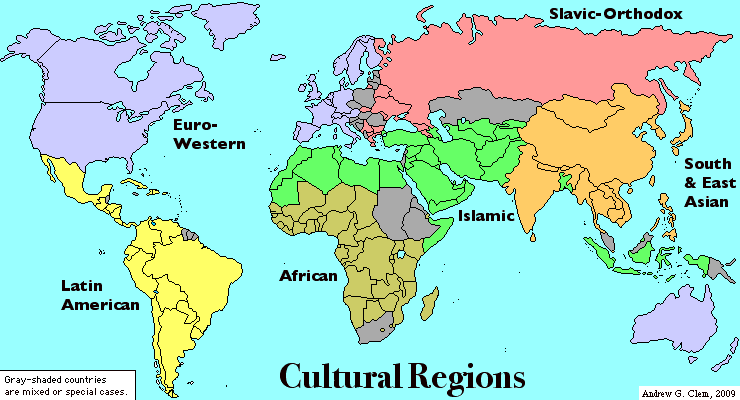
Chronology of world politics
| Year |
President |
Wars |
Other big issues and events |
| 1960 |
Eisenhower |
|
U-2, Berlin, Congo |
| 1961 |
Kennedy |
Bay of Pigs invasion; Laos |
Vienna |
| 1962 |
Kennedy |
Laos |
Cuban missile crisis |
| 1963 |
Kennedy |
Assassination of S. Vietnam Pres. Diem |
Assassination of Pres. Kennedy |
| 1964 |
Johnson |
Vietnam: Gulf of Tonkin; Laos |
Beatlemania |
| 1965 |
Johnson |
Vietnam, India-Pak. |
U.S. intervenes in Dominican Republic. |
| 1966 |
Johnson |
Vietnam |
Riots in U.S. cities |
| 1967 |
Johnson |
Vietnam, Mideast (Six-Day War) |
"Summer of Love" in S.F. |
| 1968 |
Johnson |
Vietnam Tet Offensive |
MLK, RFK assissinations, urban riots |
| 1969 |
Nixon |
Vietnam, U.S. into Cambodia |
U.S. lands on Moon; Woodstock music festival. |
| 1970 |
Nixon |
Vietnam, Cambodia, U.S. into Laos |
Terrorism, airline hijackings in Mideast. |
| 1971 |
Nixon |
Vietnam, Cambodia |
Dollar crisis, China |
| 1972 |
Nixon |
Vietnam: NVA offensive, Cambodia. |
China, USSR |
| 1973 |
Nixon |
Cambodia; Yom Kippur War |
"Peace" in Vietnam; Watergate, inflation |
| 1974 |
Nixon / Ford |
Cambodia |
Watergate, stagflation |
| 1975 |
Ford |
Commies win in Cambodia & Vietnam; Angola |
|
| 1976 |
Ford |
Angola civil war |
Bicentennial of U.S. independence |
| 1977 |
Carter |
|
U.S. human rights campaign |
| 1978 |
Carter |
|
Turmoil in Iran; Nicaragua Revolution |
| 1979 |
Carter |
China-Vietnam; USSR intrvenes in Afghanistan |
Iran Revolution |
| 1980 |
Carter |
Iraq invades Iran. |
Iran, Cuba |
| 1981 |
Reagan |
Iran counterattacks Iraq; Israel bombs Iraq. |
El Salvador civil war |
| 1982 |
Reagan |
Falklands; Lebanon; Iran-Iraq |
|
| 1983 |
Reagan |
Iran-Iraq |
Euro-missiles, SDI; |
| 1984 |
Reagan |
Iran-Iraq |
Euro-missiles, Nic.; |
| 1985 |
Reagan |
Iran-Iraq |
Euro. terrorism. Nic.; |
| 1986 |
Reagan |
Iran-Iraq |
Gorbachev-mania, Libya |
| 1987 |
Reagan |
Iran-Iraq |
Helsinki summit; Iran-Contra; Wall St. mini-crash |
| 1988 |
Reagan |
Iran-Iraq war ends. |
S & L crisis, Japan trade dispute |
| 1989 |
Bush I |
U.S. occupies Panama. |
Tienanmen Square massacre, Berlin Wall is taken down. |
| 1990 |
Bush I |
Iraq occupies Kuwait. |
Budget battles, Cold War ends, Germany reunifies. |
| 1991 |
Bush I |
Iraq/Kuwait (Desert Storm) |
Commie coup fails, USSR dissolves |
| 1992 |
Bush I |
|
Budget, Russia |
| 1993 |
Clinton |
Croatia vs. Serbia |
Health care debates; NAFTA is passed. |
| 1994 |
Clinton |
Bosnian civil war, uprising in Mexico |
GOP wins election. |
| 1995 |
Clinton |
NATO intervenes in Bosnia. |
GOP "Revolution," Clinton-Gingrich showdown. |
| 1996 |
Clinton |
|
N. Korea threatens war, Taiwan |
| 1997 |
Clinton |
|
Asian financial crisis |
| 1998 |
Clinton |
Kosovo |
Clinton impeachment |
| 1999 |
Clinton |
Al Qaeda strikes U.S.S. Cole. |
Sudan |
| 2000 |
Clinton |
|
Somalia |
| 2001 |
Bush II |
9/11 attacks by Al Qaeda; U.S. forces enter Afghanistan. |
Congress passes huge tax cut bill. |
| 2002 |
Bush II |
Afghanistan is stabilized. |
U.S. Dept. of Homeland Security is formed. |
| 2003 |
Bush II |
U.S., U.K., et al. liberate Iraq. |
WMD intelligence cast in doubt. |
| 2004 |
Bush II |
Upsurge of violence in Iraq. |
Swift Boat ads against John Kerry. |
| 2005 |
Bush II |
Iraq is destabilized. |
Abu Ghraib torture scandal; Hurricane Katrina |
| 2006 |
Bush II |
Iraq is further destabilized. |
Iran, N. Korea; Dems. win election. |
| 2007 |
Bush II |
Bush begins "Surge" in Iraq. |
Darfur genocide |
| 2008 |
Bush II |
Iraq is stabilized; violence in Afghanistan. |
Mortgage crisis, Wall St. bailouts |
| 2009 |
Obama |
Afghanistan; Sri Lanka rebels are defeated. |
"Great Recession," stimulus, Haiti & Chile earthquakes |
| 2010 |
Obama |
Obama begins "surge" in Afghanistan. |
Euro crisis; "Obamacare" health reform; tsunami in Japan |
| 2011 |
Obama |
U.S. forces kill Osama bin Laden in Pakistan. |
Euro crisis, "Arab Spring," deadlock over U.S. debt |
| 2012 |
Obama |
Afghanistan; civil war in Syria. |
Obama wins reelection vs. Romney; "fiscal cliff" looms. |
| 2013 |
Obama |
Afghanistan; civil war in Syria. |
Ed. Snowden flees U.S.; budget impasse, govt. shutdown in Oct. |
| 2014 |
Obama |
Russia seizes Crimea, etc. from Ukraine; ISIS "caliphate." |
Police kill Michael Brown in Missouri; Black Lives Matter. |
| 2015 |
Obama |
U.S. forces enter Syria to fight ISIS. |
U.S., 11 others sign Trans-Pacific Partnership (TPP). |
| 2016 |
Obama |
U.S. air attacks help Iraq retake Fallujah from ISIS. |
Trump wins election, but many suspect Russian hacking. |
| 2017 |
Trump |
U.S. attacks Syria: chem weapons? ISIS strongholds fall. |
Trump closes Mexican border, withdraws from TPP & Paris Accords. |
| 2018 |
Trump |
U.S. withdraws some forces from Syria & Afghanistan. |
U.S. withdraws from Iran nuclear deal, raises tariffs on China. |
| 2019 |
Trump |
Turkey threatens Kurdish militias in Syria. |
Mueller Report; Trump meets Kim Jong Un, is impeached over Ukraine. |
| 2020 |
Trump |
U.S. drone kills Iranian general, missile counterattack. |
covid-19 pandemic: lockdowns; Trump disputes election. |
| 2021 |
Biden |
U.S. withdraws from Afghanistan; Taliban victory. |
Jan. 6 assault on Capitol, Trump is impeached; George Floyd is killed; riots. |
| 2022 |
Biden |
Russian invasion of Ukraine; NATO sends military aid. |
Extreme heat in Europe & western U.S.; FBI seizes Trump documents. |
SOURCES: World Almanac and Book of Facts (2022), Washington Post, etc.
Top ~ General ~ International ~ National ~ State & local
National politics
"Energy in the executive is the leading character in the definition of good government."
~ Alexander Hamilton,
The Federalist #70.

The Executive Branch
The Presidency -- includes election results and a list of national conventions since 1948.
Congress
Congress -- includes a chronology of seats held by each party in the House and Senate, and the leaders thereof, since 1981.
The Judiciary
Supreme Court (year-by-year chronology of justices since 1975)
Current Supreme Court:
- Chief Justice: John Roberts (2005)
- Clarence Thomas (1991)
- Stephen Breyer (1995)
- Samuel Alito (2006)
- Sonia Sotomayor (2009)
- Elena Kagan (2010)
- Neil Gorsuch (2017)
- Brett Kavanaugh (2018)
- Amy Coney Barrett (2020)
Federal Court system
The United States Court of Appeals consists of ten "circuits" (districts). "The Ninth Federal Circuit has a well-deserved reputation as a bastion of left-liberalism, but its problems don't end there. It has 28 active judgeships and its jurisdiction encompasses western states, accounting for nearly 20 percent of the total U.S. population, which creates all sorts of distortions." (Sept. 2005.)

Political parties
Past national party chairmen:
| Term |

Democrat |

Republican |
| 1993 |
David Wilhelm / Debra DeLee |
Haley Barbour |
| 1995 |
Sen. Chris Dodd * |
Haley Barbour |
| 1997 |
Roy Romer * |
Jim Nicholson |
| 1999 |
Ed Rendell * |
Jim Nicholson |
| 2001 |
Terry McAuliffe |
Jim Gilmore / Mark Racicot |
| 2003 |
Terry McAuliffe |
Ed Gillespie |
| 2005 |
Howard Dean |
Ken Mehlman |
| 2007 |
Howard Dean |
Mike Duncan |
| 2009 |
Tim Kaine |
Michael Steele |
| 2011 |
D.B.* / Debbie Wasserman-Schultz |
Reince Priebus |
| 2013 |
Debbie Wasserman-Schultz |
Reince Priebus |
| 2015 |
D. Wasserman-Schultz / *Donna Brazile |
Reince Priebus |
| 2017 |
Donna Brazile / Tom Perez |
Ronna (Romney) McDaniel |
| 2019 |
Tom Perez |
Ronna (Romney) McDaniel |
| 2021 |
Jaime Harrison |
Ronna (Romney) McDaniel |
Asterisk (*) denotes general chairman, responsible for public speaking and fundraising, serving along with a party chairman focused on managerial duties. SOURCE: Wikipedia, etc.
Top ~ General ~ International ~ National ~ State & local
State & local politics
"All politics is local."
~ attributed to Tip O'Neill, former Speaker of the House
Politics in Virginia
Also see: National Conference of State Legislatures
Top ~ General ~ International ~ National ~ State & local
Books about politics
Aristotle, Politics introduction by Max Lerner (New York: Random House / The Modern Library, 1943 [orig. circa 340 B.C.]
Alexander Hamilton, James Madison, and John Jay, The Federalist Papers, introduction by Clinton Rossiter (New York: Mentor Books, 1961 [orig. 1788])
Niccolò Machiavelli, The Prince, introduction by Harvey C. Mansfield, Jr. (Chicago: University of Chicago Press, 1985)
Thomas Hobbes, Leviathan, introduction by John Plamenatz (Cleveland: Meridian Books, 1963)
Hans J. Morgenthau, Scientific Man and Power Politics (Chicago: Phoenix Books, 1967 [1946])
Locke, John. 1980. Second Treatise of Government. Indianapolis: Hackett Publishing.
Bruce Porter, War and the Rise of the State: The Military Foundations of Modern Politics (New York: The Free Press, 1994).
Francis Fukuyama, The End of History and the Last Man(New York: Avon Books, 1993)
Milton Friedman, Capitalism and Freedom (Chicago: Phoenix Books, 1962)
Reinhold Niebuhr, Moral Man and Immoral Society (New York: Scribners, 1932)
Charles Tilly, Coercion, Capital, and European States, AD 990-1990 (Cambridge, MA: Basil Blackwell, 1990)
Kenneth N. Waltz, Theory of International Politics (Reading, MA: Addison-Wesley, 1979)
John H. Herz, Political Realism and Political Idealism (Chicago: University of Chicago Press, 1951)
R. Douglas Arnold, The Logic of Congressional Action (New Haven: Yale University Press, 1990)
Top


