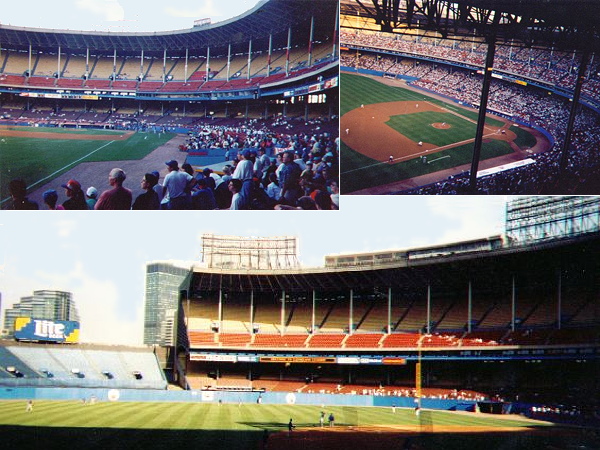
Photos below!
ALL STAR GAMES: 1935, 1954, 1963, 1981 (Four times: more than any other stadium!) LIGHTS: 1939
WORLD SERIES: 1948, 1954
"BEEN THERE": I drove by the site in 1998, but to my dismay it was already gone, as the new Browns' stadium was under construction.
Cleveland (Municipal) Stadium was the second of the Modern mid-20th Century stadiums, and had an even bigger capacity than the first one of that class, Yankee Stadium. In contrast to the fabulous success of "the House that Babe Ruth built," however, Cleveland Stadium ended up as a white elephant, and came to be known as "the Mistake on the Lake." In a way, the city of Cleveland paved the way for the pernicious trend of "stadium socialism" by paying for the construction of the gargantuan stadium where the Indians began playing in 1932. How could they ever expect a medium-size city like Cleveland to come even close to filling such a big stadium on a regular basis? (According to an "urban legend" that has been discredited, the city fathers were hoping to attract the Olympic Games in that year, but in fact, Los Angeles had already been chosen for the 1932 Olympics before construction in Cleveland even began.)
 The layout of Cleveland Stadium was laterally symmetrical but elongated, somewhat like the Polo Grounds in New York or Memorial Stadium in Baltimore, but with one side (the outfield) being much broader than the other. This showed that it was designed primarily (but not exclusively) with baseball in mind. One of its interesting features was the slope in front of the bleacher section. Since the distance to center field was so great (470 feet!), however, this slope hardly ever affected play. In fact, no one ever hit a home run into the center field bleachers!
Since not many people had enough spare cash to pay for baseball tickets during the Depression, the Indians decided to move back to their former home League Park in 1934. Then in 1936 they went back there for one game (against the Yankees), and from 1937 until 1946 (their final year in League Park) they used Municipal Stadium (as it was then called) more and more frequently, especially for Sunday and holiday games when higher attendance was expected. The Indians had two home stadiums for far longer than any other team; see Anomalous stadiums.
Soon after the Indians moved in on a permanent basis in 1947, they installed a new inner fence to make home runs easier, so that slope was no longer in play. The bullpens were moved behind the outfield fence in 1954, and were moved back to foul territory in 1966. [TT] Like many other baseball/football hybrid stadiums, there was a very large foul territory, and to bring fans closer to the action, at some point in the late 1960s, they built several additional straight rows on either side, pushing the dugouts forward by about ten feet. This reduced foul territory from about 39,500 to about 30,900 square feet.
Even though Cleveland Stadium only had two decks, the upper deck was enormous and stretched way out toward center field, thus providing ample room for 74,000 seats, more than at any other baseball stadium, aside from the anomalous Memorial Coliseum in L.A. In 1948 the Indians set a World Series attendance record of 85,000, which was the original capacity for football games. (The guy who played a decisive role in the 1948 triumph, Larry Doby, was the first black player in the American League.) For the next half century, however, the stadium was usually much less than half full, which had a depressing psychological effect on the fans and players alike. Whereas Cleveland had been one of the fastest growing urban centers in America at the beginning of the 20th century, the decline of the industrial "Rust Belt" in the 1970s left it out in the cold.
The position of the fence was shifted back and forth a few times over the years, especially in the late 1940s and late 1960s, and the dimensions listed in the table above are representative of the "stable" 1954-1964 period. From 1980 until 1990, for some reason, the distance to left center field was about ten feet shorter than in right center field. In 1976 the fence was raised from six to eight feet, and that height remained fairly constant for the rest of the stadium's life. In 1991, the outfield fence was moved back 15-20 feet to take advantage of the fact that the Cleveland outfielders were more apt at chasing long fly balls than batting them. It didn't help, so they moved the fence back in the next year.
CINEMA: Cleveland Stadium was featured in The Fortune Cookie (1966), starring Jack Lemmon and Walter Matthau, and there were some brief shots of it in the movie Major League (1989) starring Charlie Sheen and Bob "Mr. Baseball" Uecker, but all of the baseball game scenes were filmed in Milwaukee County Stadium.
The Indians' biggest stars in their glory days of the 1940s were pitcher Bob Feller (who served in the Navy during World War II) and shortstop/manager Lou Boudreau, both of whom were elected to the Hall of Fame. In the 1960s Rocky Colavito led the team on a few pennant races. As the stadium and the city rusted away in the 1980s, the team became a perennial bottom-dweller, as satirized in the movie Major League. But from the depths of despair there arose a new winning spirit in Cleveland, helped by municipal subsidies that made possible a beautiful new asymmetrical ballpark several blocks away: Jacobs Field, now called "Progressive Field"! At least this time, the taxpayers' money was better spent than in 1932! Apparently few people if anyone missed the old stadium very much.
The Cleveland Rams played football here in 1937, 1939-1942, and 1944-1945, after which they moved to Los Angeles. The Cleveland Browns did likewise from 1946 until 1995, after which they relocated to Baltimore and became the "Ravens." Even though many of the seats were far away from the gridiron, and hidden in the shadows on those bleak November afternoons, the stadium nevertheless generated a unique thrilling atmosphere. The blue-collar fans congregated in the bleacher section next to the east end zone, an area that was known as "the Dawg Pound." Browns players who scored touchdowns on that side often kept running up the slope into the arms of their adoring fans. Some people thought they could keep the Browns in Cleveland by rebuilding Cleveland Stadium to better suit football games, hence the hypothetical alternative diagram above. That would have involved removing the roof, expanding the upper deck by about eight rows, replacing the rear half of the lower deck with new concourse areas and luxury suites, and adding about eight rows in front of the lower deck, while lowering the playing field by about three feet. Like at Yankee Stadium (1976) and Soldier Field (2006), it would have extended the life of the historic structure while radically changing the atmosphere. I estimate the seating capacity would have declined to about 70,000. It just ain't the same at the new Browns Stadium (now called First Energy Stadium), which was built on this same site in 1999 -- three years after Cleveland Stadium was demolished.
SOURCES: Lowry (2006); Pastier (2007); Gershman (1993); digitalballparks.com; baseball-fever.com; sportsecyclopedia.com; Take Me Out to the Ballpark Calendar 2006
FAN TIP: Tom Tomsick
| The Clem Criteria: | |||||
|---|---|---|---|---|---|
| Field asymmetry |
Architectural design |
Seat proximity |
Location * | Aesthetics | Overall |
| 3 | 5 | 4 | 5 | 3 | 4.0 |
* See the Stadium locations page.