Photo below!


BEEN THERE (too late): I visited the site of Baker Bowl on Sept. 4, 2016, four days after seeing a Nationals - Phillies game.
ALL-STAR GAMES: none WORLD SERIES: 1915 (loss) LIGHTS: never
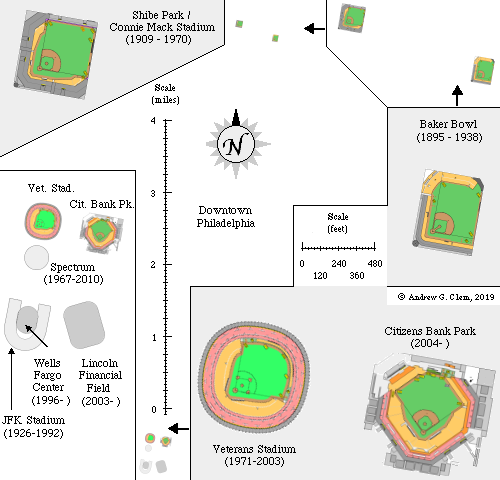
The Baker Bowl (named for William Baker, who owned the Phillies from 1913 to 1930) was one of the major league ballparks whose existence I was unaware of until I read Phil Lowry's book Green Cathedrals. When it was built in 1895, it was a state-of-the-art facility, the first baseball stadium whose grandstand was built of concrete and steel. (The bleachers were always wooden.) It became totally outclassed during the stadium construction boom of the 1910s, however, and for the next twenty years the Phillies played in the tiny ballpark that gradually decayed and became a dilapidated joke, often derided as the "cigar box" or "band box." Sections of the upper deck collapsed on two occasions. In August 1903, eleven fans were killed, and the Phillies played for the rest of the season in the Athletics' home field, Columbia Park. When a portion of the upper deck collapsed in May 1927, many fans were injured but no one died. For two weeks while repairs were made, the Phillies played their home games in Shibe Park, which would eventually become their permanent home.
 A railroad switching yard was located across the street from right field, which had absurdly short dimensions that were partly offset by a 40-foot high wall and (after 1915) a 20-foot in-play fence on top of that. It was much like Cleveland's League Park. A railroad tunnel under deep center field created a slight bulge in the surface out there. The franchise clubhouse in center field sometimes had seating on the top, and there were also bleachers in front of it in some years. Although extremely asymmetrical in one sense, nearly all the fences and stadium structures were at perpendicular angles to each other, a very uninteresting design. The octagonal "turret" where patrons paid and entered was an intriguing oddity, as were the castle ramparts that were originally located on top of both ends of the second deck. Only one World Series was played there, in 1915, and the Phillies lost to the Red Sox. During the Depression it was just too costly to make continual repairs, so in 1938 the Phillies moved into Shibe Park across town and became tenants of the Philadelphia Athletics. The Baker Bowl was demolished in 1950, and no one seemed to miss it.
Baker Bowl was the first stadium to have a cantilevered upper deck, with virtually all of the seats located in front of the support columns. The entry portals were in back of those columns. Many details about the early years remain unclear, but it is known that the diamond was rotated about three degrees counter-clockwise in the early teens, and was then restored to a straight-forward orientation in 1922. Afte that, there were relatively few changes.
In 1924, the Philadelphia Hilldales hosted the Kansas City Monarchs in the first-ever Negro World Series, using the Baker Bowl for the special occasion. (The team's usual home ballpark was Hilldale Park, in the western suburb of Darby / Yeardon.)
In 1933, the Philadelphia Eagles were created as a new franchise in the National Football League, making their home at Baker Bowl. They only won three of fifteen games they played there, however, and after the 1935 season was over they decided to move to Municipal Stadium, on the south side of the city. (The Eagles only stayed there for a few years, however. Later on, in 1964, Municipal Stadium was renamed John F. Kennedy Stadium.)
SOURCES: Lowry (2017), Ray Didinger & Robert S. Lyons, The Eagles Encyclopedia
FAN TIP: Terry Wallace, Mark Komp
| The Clem Criteria: | |||||
|---|---|---|---|---|---|
| Field asymmetry |
Architectural design |
Seat proximity |
Location * | Aesthetics | Overall |
| 7 | 4 | 5 | 4 | 4 | 4.8 |
* See the Stadium locations page.